

A Complete Guide to NCLT Insolvency Proceedings for Businesses in Delhi NCR
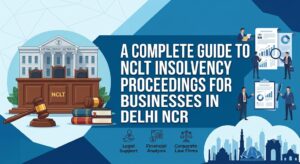
Navigating corporate financial distress or recovering unpaid commercial debts in Delhi NCR requires a precise understanding of Indian insolvency law. The National Company Law Tribunal (NCLT) serves as the primary adjudicating authority for corporate insolvency under the Insolvency and Bankruptcy Code, 2016 (IBC).
Whether you are an operational creditor trying to recover pending invoices, a financial institution managing non-performing assets, or a corporate debtor seeking structured debt resolution, this guide explains the legal frameworks, procedural stages, statutory timelines, penalty provisions, and fee structures governing NCLT proceedings in Delhi NCR.
What is NCLT and Its Role in Insolvency Proceedings?
The National Company Law Tribunal (NCLT) is a quasi-judicial body constituted under Section 408 of the Companies Act, 2013. In the context of corporate insolvency, the NCLT functions as the Adjudicating Authority for matters falling under the Insolvency and Bankruptcy Code (IBC).
In the Delhi National Capital Region (Delhi NCR), insolvency cases are adjudicated by:
-
NCLT Principal Bench & Existing Benches: Located at CGO Complex, Lodhi Road, New Delhi.
-
NCLT Gurugram & NCLT Noida Jurisdiction Benches: Handling corporate entities registered within Haryana and Uttar Pradesh, respectively.
Primary Functions of NCLT in Insolvency
-
Adjudicating Insolvency Petitions: Admitting or rejecting applications filed by financial creditors, operational creditors, or corporate debtors.
-
Imposing Moratorium (Section 14): Halting all parallel recovery proceedings, civil suits, and asset execution orders against the corporate debtor upon admission.
-
Appointing Resolution Professionals: Ratifying the appointment of the Interim Resolution Professional (IRP) and Resolution Professional (RP).
-
Approving Resolution Plans: Reviewing and approving resolution plans voted on by the Committee of Creditors (CoC).
-
Ordering Liquidation: Initiating corporate liquidation if no viable resolution plan is presented or approved within the statutory timeline.
Key Legal Provisions Under the Insolvency and Bankruptcy Code (IBC)
The minimum threshold of default to initiate insolvency proceedings before the NCLT stands at ₹1 Crore (revised post-COVID-19 to protect small enterprises).
| Section | Initiator | Key Requirement / Mechanism |
| Section 7 | Financial Creditors (Banks, NBFCs, Homebuyers) | Direct application upon proving default of financial debt. No prior demand notice is strictly mandatory, though proof of default via Information Utility (NeSL) or bank records is essential. |
| Section 8 | Operational Creditors (Suppliers, Vendors, Service Providers) | Mandatory issuance of a 10-day Statutory Demand Notice in Form 3 or Form 4 to the corporate debtor before filing an insolvency petition. |
| Section 9 | Operational Creditors | Petition filed post expiry of the 10-day demand notice, provided the debtor has neither paid nor raised a pre-existing dispute. |
| Section 10 | Corporate Debtor (Self-Filing) | Application filed by the company itself upon passing a special resolution by its shareholders/partners. |
| Section 12 | Statutory Timeline | Mandates completion of CIRP within 180 days, extendable by 90 days, with an absolute outer limit of 330 days including litigation time. |
| Section 14 | Automatic Stay / Moratorium | Prohibits institutional recovery, arbitration, asset transfers, or property enforcement during CIRP. |
| Section 12A | Application Withdrawal | Permits withdrawal of an admitted CIRP petition if supported by 90% voting share of the Committee of Creditors. |
The Intersection of IBC with Criminal Law (IPC & BNS)
While the IBC is fundamentally a civil and economic remedy, insolvency proceedings often intersect with criminal law—especially when financial fraud, diversion of funds, or asset siphoning occurs prior to or during the Corporate Insolvency Resolution Process (CIRP).
With the implementation of India’s revised criminal laws—the Bharatiya Nyaya Sanhita, 2023 (BNS) replacing the Indian Penal Code (IPC)—promoters and officers in default face dual scrutiny under statutory regulatory frameworks and criminal statutes.
       ┌─────────────────────────────────────────────────────────┐
       │             Corporate Default / Distress                 │
       └────────────────────────────┬────────────────────────────┘
                                    │
           ┌────────────────────────┴────────────────────────┐
           ▼                                                 ▼
┌───────────────────────────────┐                 ┌───────────────────────────────┐
│     Insolvency Track (IBC)    │                 │   Criminal Track (BNS / IPC)  │
├───────────────────────────────┤                 ├───────────────────────────────┤
│ • NCLT Petition (Sec 7 / 9)   │                 │ • Fraud / Cheating (BNS 318)  │
│ • Moratorium Freeze (Sec 14)  │                 │ • Breach of Trust (BNS 316)   │
│ • Fraudulent Trading (Sec 66) │                 │ • Forgery / Fabricated Books  │
│ • Asset Recovery / Resolution │                 │ • Personal Liability & Custody│
└───────────────────────────────┘                 └───────────────────────────────┘
Key Criminal Provisions Relevant to Insolvency
-
Cheating & Dishonestly Inducing Delivery of Property:
-
Legacy Provision: IPC Section 420
-
Current Provision: BNS Section 318(4)
-
Application: Triggered when promoters solicit loans or commercial credit while concealing pre-existing insolvency or submitting fraudulent financial records.
-
-
Criminal Breach of Trust by Corporate Officers / Bankers:
-
Legacy Provision: IPC Section 409
-
Current Provision: BNS Section 316(5)
-
Application: Invoked when directors or key managerial personnel misappropriated funds designated for specific corporate operations or escrow accounts.
-
-
Dishonest Removal or Concealment of Property to Prevent Distribution:
-
Legacy Provision: IPC Section 421 & Section 422
-
Current Provision: BNS Section 321 & Section 322
-
Application: Direct criminal liability for promoters who secretively transfer company assets or execute sham transactions prior to insolvency to defeat creditor claims.
-
-
Forgery of Documents / Financial Statements:
-
Legacy Provision: IPC Section 468 & Section 471
-
Current Provision: BNS Section 336 & Section 340
-
Application: Submitting altered balance sheets, fake invoices, or forged board resolutions before the NCLT or financial institutions.
-
IBC Internal Penalties (Sections 65 & 66)
-
Section 65: Imposes penalties ranging from ₹1 Lakh to ₹1 Crore for initiating fraudulent or malicious insolvency proceedings.
-
Section 66: Holds directors personally liable without limitation for Fraudulent or Wrongful Trading carried out to defraud creditors during insolvency.
Step-by-Step Corporate Insolvency Resolution Process (CIRP)
[Default Occurs (Min ₹1 Cr)] ──► [Section 8 Notice (Operational Creditors)]
                                                │
[Admission Order & Moratorium] ◄── [File Petition at NCLT Delhi Bench]
             │
             ├──► [IRP Takes Control & Suspends Board]
             ├──► [Public Announcement & Call for Claims]
             ├──► [Formation of Committee of Creditors (CoC)]
             ├──► [RP Invites & Evaluates Resolution Plans]
             │
   ┌─────────┴────────────────────────┐
   ▼                                  ▼
[Plan Approved by CoC & NCLT]    [Plan Rejected / Fails]
   │                                  │
[Company Restructured]            [Liquidation Order Passed]
Stage 1: Pre-Filing & Statutory Notice
-
Confirm the debt default exceeds the ₹1 Crore threshold.
-
Operational creditors issue a 10-day Demand Notice under Section 8.
-
Financial creditors collect default proof from National E-Governance Services Limited (NeSL).
Stage 2: Filing the Petition
-
Prepare the petition bundle (Form 1 for Financial Creditors, Form 5 for Operational Creditors, Form 6 for Corporate Debtors) along with supporting agreements, bank statements, and affidavits.
-
Submit electronically via the NCLT e-filing portal and file physical sets at the relevant Delhi NCR Bench registry.
Stage 3: Hearing & Admission
-
The NCLT examines the petition for completeness, existence of debt/default, and absence of pre-existing dispute.
-
Upon admission, the NCLT issues an order:
-
Declaring a Moratorium under Section 14.
-
Appointing an Interim Resolution Professional (IRP).
-
Stage 4: Management Transfer & Public Announcement
-
The IRP takes immediate custody of company assets and bank accounts; the power of the Board of Directors stands suspended.
-
Public announcements are published in two local newspapers and on the IBBI portal inviting creditor claims within 14 days.
Stage 5: Constitution of Committee of Creditors (CoC)
-
The IRP verifies claims and constitutes the CoC (comprising financial creditors).
-
The CoC holds its first meeting within 7 days of constitution and votes to confirm the IRP or appoint a new Resolution Professional (RP).
Stage 6: Resolution Plan vs. Liquidation
-
The RP issues an Expression of Interest (EOI) inviting prospective resolution applicants to submit restructuring plans.
-
If a resolution plan secures 66% voting approval from the CoC and subsequent NCLT approval, the business is handed over to the new successful applicant.
-
If no plan is approved within 180–330 days, NCLT passes a Liquidation Order under Section 33.
Estimated Fees and Costs in NCLT Proceedings
Engaging in NCLT litigation involves statutory court fees, resolution professional expenses, and professional advocate fees.
1. Statutory NCLT Court Filing Fees
-
Section 7 (Financial Creditors): ₹25,000
-
Section 9 (Operational Creditors): ₹2,000
-
Section 10 (Corporate Debtor): ₹25,000
-
Interlocutory Applications (IA): ₹1,000 – ₹2,500
2. Resolution Professional (IRP/RP) & Initial Process Costs
-
Initial CIRP Cost Advance: Creditors typically advance ₹2,000,000 to ₹5,000,000 to cover immediate public announcements, valuer fees, and initial IRP fee caps. These costs are prioritized for reimbursement under the final resolution plan.
3. Legal & Professional Advocate Fees (Delhi NCR Standard Rates)
-
Drafting & Petition Filing: ₹75,000 – ₹3,50,000 (varies based on documentation complexity).
-
Per Hearing Appearance Fee: ₹15,000 – ₹1,00,000 (depending on advocate seniority).
-
End-to-End CIRP Legal Representation: Case-specific retainerships structured around milestones.
Hidden Truths & Practical Realities of NCLT Litigation
While the IBC was designed as a swift 180-day resolution mechanism, ground realities in Delhi NCR tribunals involve distinct strategic nuances:
1. NCLT is Not a Simple Recovery Forum
The Supreme Court of India has repeatedly held that NCLT is an insolvency resolution authority, not a civil recovery court. Filing petitions solely to intimidate debtors without genuine default parameters often leads to dismissal and heavy penalties under Section 65.
2. The “Pre-Existing Dispute” Trap (Mobilox Principle)
Under Section 9 filings, if the corporate debtor produces email exchanges, WhatsApp messages, or legal notices sent before the Section 8 demand notice showing dissatisfaction over product/service quality, the NCLT will dismiss the petition. Operational creditors must establish that no dispute existed prior to the demand notice.
3. Promoter Loss of Control
Many corporate debtors file Section 10 applications expecting debt relief while retaining business management. The moment CIRP is admitted, the promoter loses management control completely. Furthermore, Section 29A of the IBC strictly prohibits defaulting promoters from bidding for their own company during the resolution plan stage.
4. Overburdened Benches & Realistic Timelines
Due to high litigation volume across Delhi NCR, the statutory 14-day admission timeline frequently extends to 6–12 months in practice. Proper documentation at the filing stage is critical to avoiding registry defects and procedural delays.
Actionable Tips for Businesses in Delhi NCR
For Operational Creditors (Suppliers & Service Providers)
-
Maintain Meticulous Pre-Notice Documentation: Ensure all purchase orders, invoices, delivery challans, GST filings, and email communications are archived.
-
Inspect Communication History Before Notice: Audit all historic emails to verify that the debtor has not raised quality or defect disputes before issuing a Section 8 notice.
-
Leverage Information Utilities: Register debts on NeSL to establish record of default early.
For Corporate Debtors & Promoters
-
Engage in Pre-Admission Settlements: If a debt is undisputed, resolve or structure a settlement before the NCLT formally admits the petition and imposes a moratorium.
-
Audit Historical Transactions: Review past 2 years’ transactions for preferential (Section 43), undervalued (Section 45), or fraudulent (Section 66) transfers, as Resolution Professionals conduct exhaustive forensic audits.
-
Prepare Financial Disclosures Early: Ensure balance sheets, asset registers, and bank reconciliation statements are updated to handle proceedings without procedural delays.
Strategic NCLT Representation with Lex Pleaders
Handling corporate insolvency requires a balance of statutory knowledge, corporate strategy, and court representation. Lex Pleaders provides corporate legal services across Delhi NCR, representing financial institutions, corporate debtors, resolution professionals, and operational creditors before the NCLT Principal Bench (New Delhi), NCLT Gurugram, NCLT Noida, and the NCLAT.
Contact Lex Pleaders
-
Office Location: Delhi, India
-
Direct Phone: +91 8595333579
-
Official Website: https://lexpleaders.com/
-
Core Expertise: Corporate Insolvency (IBC), NCLT/NCLAT Litigation, Section 7/9 Petitions, Debt Restructuring, Commercial Litigation & BNS Offence Defence.