


Cheque Bounce Cases in India: Complete Legal Guide Under Section 138 of the Negotiable Instruments Act.
Introduction
In the modern commercial world, cheques remain one of the most commonly used instruments for payments in business transactions, loans, property dealings, and contractual obligations. Despite the rise of digital banking, cheques continue to play a significant role in financial dealings across India. However, disputes often arise when a cheque issued by a person is returned unpaid by the bank. This situation is commonly referred to as “cheque bounce” or “dishonour of cheque.”
A cheque bounce can have serious legal consequences. Indian law treats dishonour of a cheque for insufficient funds as a criminal offence under Section 138 of the Negotiable Instruments Act, 1881. The provision was introduced to strengthen the credibility of cheque transactions and ensure financial discipline in commercial dealings.
When a cheque is dishonoured, the payee (the person receiving the cheque) has legal rights to recover the money through criminal proceedings and other legal remedies. The law provides a structured procedure involving a legal notice, waiting period, and filing of a complaint before the appropriate court.
This comprehensive guide explains everything you need to know about cheque bounce cases in India, including:
-
What cheque bounce means in legal terms
-
Common reasons for dishonour of cheques
-
Legal provisions under the Negotiable Instruments Act
-
Step-by-step procedure to file a cheque bounce case
-
Punishment and penalties under Indian law
-
Defences available to the accused
-
Important Supreme Court and High Court judgments
-
Practical advice for individuals and businesses
The aim of this article is to provide a clear, practical, and legally accurate explanation so that even a person with no legal background can understand their rights and obligations.
What is a Cheque Bounce?
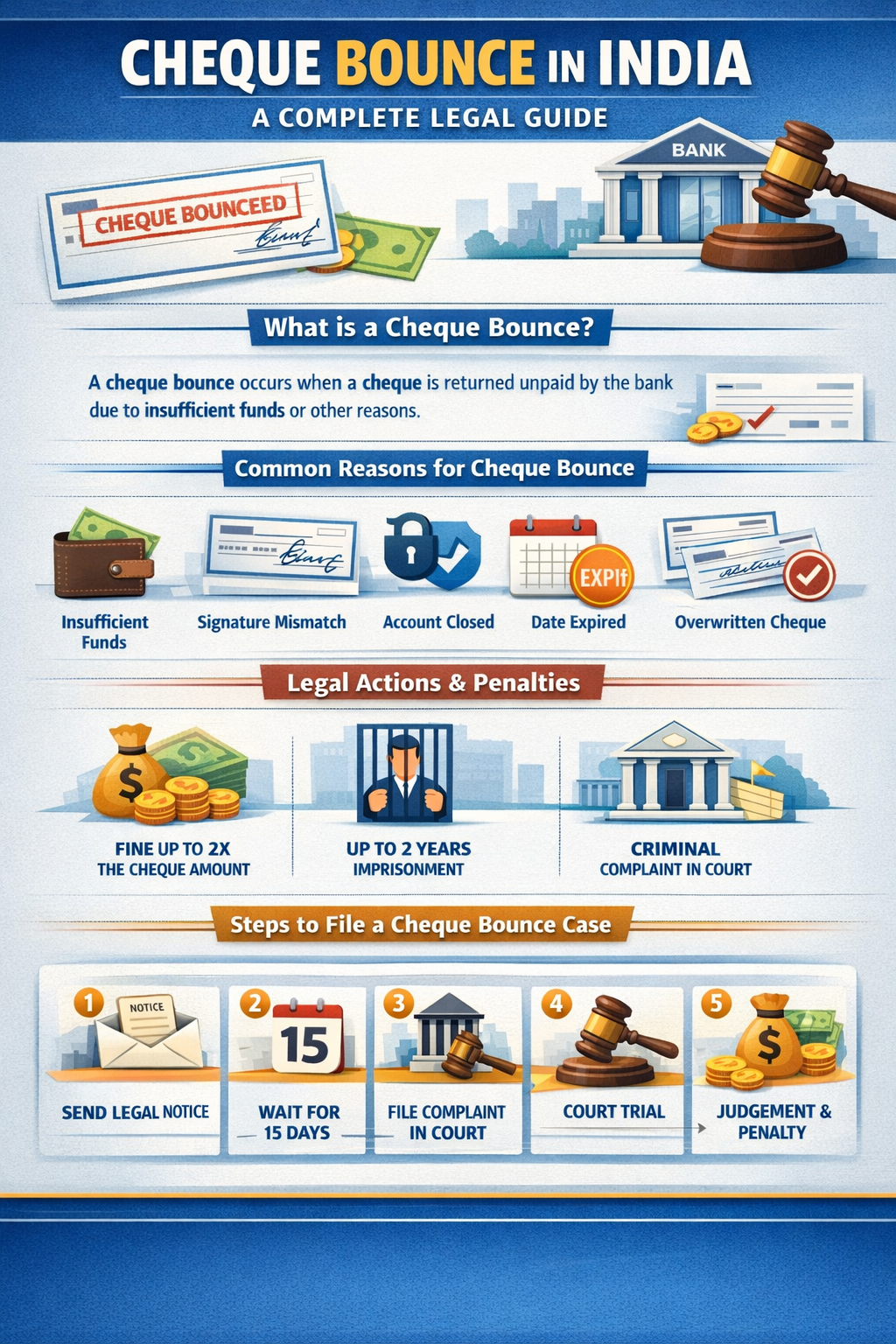
A cheque bounce occurs when a cheque presented to a bank for payment is returned unpaid by the bank. This usually happens because the account of the person issuing the cheque does not have sufficient funds or due to certain technical or procedural defects.
When the bank refuses payment, it issues a document called a Cheque Return Memo that mentions the reason for dishonour.
Under Indian law, if a cheque issued towards payment of a legally enforceable debt or liability is dishonoured due to insufficient funds, it may lead to criminal prosecution under Section 138 of the Negotiable Instruments Act, 1881.
The purpose of this provision is to ensure that cheques are treated as reliable financial instruments.
Legal Framework Governing Cheque Bounce in India
Cheque bounce cases in India are governed primarily by the following laws:
1. Negotiable Instruments Act, 1881
The key provisions include:
-
Section 138 – Dishonour of cheque for insufficiency of funds
-
Section 139 – Presumption in favour of holder
-
Section 140 – Defence not allowed in certain cases
-
Section 141 – Offences by companies
-
Section 142 – Cognizance of offences
-
Section 143 – Summary trial
-
Section 144 – Service of summons
-
Section 145 – Evidence by affidavit
-
Section 147 – Compounding of offences
2. Code of Criminal Procedure, 1973
Cheque bounce cases are criminal proceedings and are therefore governed by procedural rules under the CrPC.
3. Indian Evidence Act, 1872
This law governs how evidence is presented in court.
Essential Ingredients of Section 138 NI Act
For a person to be held liable under Section 138, the following conditions must be satisfied:
-
A cheque must be issued by the accused.
-
The cheque must be issued towards discharge of a legally enforceable debt or liability.
-
The cheque must be presented to the bank within its validity period.
-
The cheque must be returned unpaid.
-
A legal notice must be issued to the drawer within 30 days of receiving the return memo.
-
The drawer must fail to pay within 15 days of receiving the notice.
Only after all these conditions are fulfilled can a criminal complaint be filed.
What is a Cheque Bounce Legal Notice?
A cheque bounce legal notice is a formal communication sent by the payee to the person who issued the cheque demanding payment of the cheque amount.
The notice serves several purposes:
-
Informing the drawer that the cheque has been dishonoured
-
Providing an opportunity to make payment
-
Creating legal evidence before filing a complaint
The notice must be sent within 30 days from the date of receipt of the bank return memo.
If the drawer fails to make payment within 15 days from the receipt of the notice, the payee becomes entitled to file a criminal case.
How to Know if a Cheque Has Bounced
When a cheque is dishonoured, the bank informs the concerned parties through multiple ways.
Bank Return Memo
The bank issues a written memo stating the reason for dishonour.
SMS or Email Notification
Banks often send messages to the account holder notifying them of the dishonour.
Intimation to Payee’s Bank
The payee’s bank also receives information regarding the dishonour.
The memo contains:
-
Cheque number
-
Date of cheque
-
Reason for dishonour
-
Date of return
This memo is crucial evidence in legal proceedings.
Common Reasons for Cheque Bounce
Cheque dishonour can occur for several reasons.
1. Insufficient Funds
This is the most common reason. The bank account does not have enough balance to cover the cheque amount.
2. Signature Mismatch
The signature on the cheque does not match the bank records.
3. Post-Dated Cheque Presented Early
If a cheque is presented before the date mentioned on it.
4. Overwriting on Cheque
Changes in the amount, name, or date without authentication.
5. Account Closed
If the drawer has closed the bank account.
6. Payment Stopped by Drawer
The drawer instructs the bank not to honour the cheque.
7. Expired Cheque
A cheque becomes invalid after three months from the date of issue.
8. Incorrect Account Details
Errors in account number or payee details.
Each reason has different legal implications.
Legal Consequences of Cheque Bounce
If the cheque bounce satisfies the conditions under Section 138, the drawer can face criminal liability.
The consequences include:
-
Criminal prosecution
-
Monetary penalties
-
Imprisonment
-
Civil recovery proceedings
The law aims to maintain trust in financial transactions.
Punishment for Cheque Bounce
The punishment under Section 138 includes:
Imprisonment
Up to two years in jail.
Monetary Penalty
Fine up to twice the cheque amount.
Both
The court may impose both imprisonment and fine.
Courts often prefer monetary compensation to ensure the complainant receives the due amount.
Step-by-Step Procedure to File a Cheque Bounce Case
The legal procedure involves several stages.
Step 1: Present the Cheque to the Bank
The cheque must be presented within its validity period.
Step 2: Obtain the Cheque Return Memo
If the cheque is dishonoured, the bank issues the memo.
Step 3: Send Legal Notice
The payee must send a legal notice within 30 days.
Step 4: Wait for 15 Days
The drawer is given 15 days to make payment.
Step 5: File Criminal Complaint
If payment is not made, the complaint must be filed before the Magistrate Court within 30 days after the expiry of the notice period.
Step 6: Court Proceedings
The court may issue summons to the accused and conduct trial.
Jurisdiction for Filing Cheque Bounce Case
Jurisdiction is determined by the place where the cheque is presented for collection.
The Supreme Court clarified this in:
Dashrath Rupsingh Rathod v. State of Maharashtra (2014)
Later modified by the Negotiable Instruments (Amendment) Act, 2015.
Now the case can be filed at the place where the payee’s bank is located.
Evidence Required in Cheque Bounce Case
Key documents include:
-
Original cheque
-
Cheque return memo
-
Copy of legal notice
-
Postal receipt
-
Proof of delivery
-
Bank statements
-
Agreement or transaction documents
Defences Available to the Accused
The accused can defend themselves through various legal arguments.
No Legally Enforceable Debt
If the cheque was issued as security.
Cheque Lost or Misused
If someone misused a signed cheque.
Stop Payment with Valid Reason
Where payment was stopped due to dispute.
Bank Error
Technical issues causing dishonour.
Proof of Payment
If the debt has already been cleared.
Evidence such as bank statements and witness testimony may support these defences.
Important Supreme Court Judgments on Cheque Bounce
Rangappa v. Sri Mohan (2010)
The Supreme Court held that courts must presume the cheque was issued for debt unless proven otherwise.
Meters and Instruments Pvt Ltd v. Kanchan Mehta (2018)
Encouraged early settlement of cheque bounce cases.
Dashrath Rupsingh Rathod v. State of Maharashtra (2014)
Clarified territorial jurisdiction.
Bir Singh v. Mukesh Kumar (2019)
Even blank signed cheques can attract liability.
Liability of Companies in Cheque Bounce Cases
If a cheque is issued by a company:
-
The company
-
Directors responsible for business
-
Authorized signatories
can be held liable under Section 141 of the NI Act.
Service of Summons in Cheque Bounce Cases
Under Section 144 of the Negotiable Instruments Act, summons may be served through registered post or courier.
This provision simplifies the legal process.
Settlement and Compounding of Cheque Bounce Cases
Section 147 of the NI Act allows compounding.
This means:
-
Parties may settle the dispute
-
The court may close the case
-
Payment with compensation is common
Courts encourage settlement to reduce litigation.
Bank Charges for Cheque Bounce
Banks also impose penalties when a cheque is dishonoured.
Charges vary across banks and may apply to both:
-
Drawer
-
Payee
Civil Remedies for Cheque Bounce
Apart from criminal proceedings, the payee may file a civil suit for recovery of money.
This allows recovery with interest and damages.
How to Respond if You Receive a Cheque Bounce Notice
If you receive a notice:
-
Read the notice carefully
-
Verify the cheque details
-
Consult a lawyer
-
Reply within the stipulated time
-
Consider settlement if possible
A reply should include:
-
Explanation for dishonour
-
Legal defence
-
Proposed resolution
Preventing Cheque Bounce Disputes
Individuals and businesses can avoid disputes by:
-
Maintaining sufficient balance
-
Issuing cheques carefully
-
Recording financial transactions
-
Avoiding blank signed cheques
-
Using written agreements
Frequently Asked Questions:
1. What happens if a cheque bounces in India?
When a cheque is returned unpaid by the bank due to insufficient funds or other reasons, it is called a cheque bounce. Under Section 138 of the Negotiable Instruments Act, 1881, the drawer may face criminal prosecution. The punishment may include imprisonment up to two years, a fine up to twice the cheque amount, or both.
2. Is cheque bounce a criminal offence in India?
Yes. Cheque bounce due to insufficient funds is considered a criminal offence under Section 138 of the Negotiable Instruments Act, 1881. If the drawer fails to pay within 15 days after receiving a legal notice, the payee can file a criminal complaint before the Magistrate Court.
3. What is the punishment for cheque bounce in India?
The punishment for cheque bounce may include:
-
Imprisonment up to two years
-
Fine up to twice the cheque amount
-
Both imprisonment and fine
Courts usually also direct the accused to pay compensation to the complainant.
4. What is the time limit for sending a cheque bounce notice?
A legal notice must be sent within 30 days from the date of receiving the cheque return memo from the bank. If the drawer does not pay the amount within 15 days after receiving the notice, the payee can file a complaint before the court.
5. What are the common reasons for cheque bounce?
Cheques may bounce due to several reasons including:
-
Insufficient funds
-
Signature mismatch
-
Account closed
-
Stop payment instruction
-
Overwriting on cheque
-
Mismatch in amount written in words and figures
-
Expired cheque
Banks mention the reason in the cheque return memo.
6. Can a cheque bounce case be settled?
Yes. Cheque bounce cases can be settled or compounded at any stage of the proceedings. Courts encourage settlement because the primary objective of the law is recovery of money rather than punishment.
7. How long does a cheque bounce case take in India?
A cheque bounce case usually takes 1 to 3 years depending on factors such as court workload, availability of evidence, and cooperation of parties. However, courts often encourage early settlement.
8. Can a cheque bounce case be filed without a lawyer?
Technically, a person can file a complaint themselves before a Magistrate court. However, cheque bounce cases involve legal procedures and evidence, so consulting a lawyer is strongly recommended to ensure proper filing and representation.
9. What documents are required to file a cheque bounce case?
Important documents include:
-
Original cheque
-
Bank return memo
-
Copy of legal notice
-
Postal receipt or courier proof
-
Proof of delivery of notice
-
Supporting documents showing debt or liability
These documents are necessary to establish the offence under Section 138.
10. Can a cheque bounce case be filed online in India?
Generally, cheque bounce complaints must be filed physically before the jurisdictional Magistrate Court. However, some courts allow electronic filing through e-courts portals depending on the state.
11. What is a cheque return memo?
A cheque return memo is a document issued by the bank when a cheque is dishonoured. It specifies the reason for non-payment, the cheque number, and the date of dishonour. This document is essential evidence in cheque bounce proceedings.
12. Can a blank signed cheque lead to a cheque bounce case?
Yes. According to the Supreme Court in Bir Singh v. Mukesh Kumar (2019), even a blank signed cheque given voluntarily may create legal liability if it was issued towards repayment of a debt.
13. What is the validity of a cheque in India?
A cheque is valid for three months from the date written on it. If it is presented after this period, the bank will treat it as expired and refuse payment.
14. Can a cheque bounce case be filed against a company?
Yes. Under Section 141 of the Negotiable Instruments Act, when a cheque issued by a company is dishonoured, the company and the directors responsible for its business operations may be held liable.
15. What happens if the accused does not respond to the legal notice?
If the drawer ignores the legal notice and does not make payment within 15 days, the payee has the legal right to file a criminal complaint under Section 138 before the Magistrate Court.
16. Can stop payment instructions lead to cheque bounce liability?
Yes. Even if the drawer instructs the bank to stop payment, the cheque bounce provisions may still apply if the cheque was issued to discharge a legally enforceable debt.
17. What court handles cheque bounce cases?
Cheque bounce cases are usually tried by Judicial Magistrate First Class or Metropolitan Magistrate courts. These courts have jurisdiction under the Negotiable Instruments Act.
18. Can the complainant withdraw a cheque bounce case?
Yes. The complainant can withdraw the case if the parties reach a settlement. Courts usually permit withdrawal after payment of the cheque amount along with compensation.
19. What happens if the accused is found guilty in a cheque bounce case?
If the court finds the accused guilty, it may order:
-
Payment of the cheque amount
-
Compensation to the complainant
-
Imprisonment up to two years
-
Fine up to double the cheque amount
20. How can cheque bounce disputes be avoided?
Cheque bounce disputes can be avoided by:
-
Maintaining sufficient balance in bank accounts
-
Issuing cheques carefully
-
Avoiding blank signed cheques
-
Recording financial transactions through written agreements
-
Using secure payment methods for large transactions
Conclusion
Cheque bounce disputes are among the most common financial litigations in India. The law provides a structured legal remedy to ensure that financial commitments are honoured and that cheque transactions remain trustworthy.
Section 138 of the Negotiable Instruments Act acts as a deterrent against financial misconduct while also protecting the interests of creditors and businesses.
For individuals and companies dealing with cheque dishonour issues, it is advisable to seek legal assistance at an early stage. Timely legal action not only helps recover money but also strengthens financial discipline in commercial transactions.