

Loan Recovery Agent Harassment in India: Your Legal Rights, RBI Guidelines, and How to Stop Debt Recovery Harassment
Introduction
Many borrowers in India face intimidation and harassment from loan recovery agents when they default on loan payments. While banks and financial institutions have the legal right to recover outstanding dues, they cannot threaten, abuse, or intimidate borrowers.
Unfortunately, some recovery agents adopt aggressive tactics such as repeated phone calls, public humiliation, threats of arrest, and pressure on family members. These actions are illegal and violate the Reserve Bank of India (RBI) guidelines on recovery practices.
The RBI has issued strict regulations for banks, NBFCs, and recovery agents to ensure that loan recovery is conducted in a fair, ethical, and lawful manner. Borrowers must understand that defaulting on a loan does not mean surrendering fundamental rights or personal dignity.
Harassment by recovery agents has been widely reported across India, where borrowers are subjected to abusive calls, threats, and privacy violations.
Pasted text
This comprehensive legal guide explains:
-
Your rights as a borrower in India
-
RBI rules for loan recovery agents
-
Illegal practices used by recovery agents
-
Steps to stop loan harassment
-
Legal remedies against recovery agents
-
When banks can take legal action for loan recovery
Understanding Loan Recovery in India
When a borrower fails to repay a loan according to the agreed schedule, the account may become:
-
Overdue
-
Special Mention Account (SMA)
-
Non-Performing Asset (NPA)
At this stage, banks may attempt recovery through:
-
Internal recovery departments
-
External recovery agents
-
Legal proceedings
-
Debt Recovery Tribunals (DRT)
-
SARFAESI proceedings for secured loans
However, RBI clearly prohibits harassment or coercive methods during recovery.
Common Forms of Loan Recovery Harassment in India
Borrowers frequently report several forms of harassment by recovery agents.
1. Continuous Phone Calls
Some agents call borrowers multiple times a day, sometimes from different numbers.
This may include:
-
Calls late at night
-
Calls early in the morning
-
Automated harassment calls
Such conduct violates RBI recovery guidelines.
2. Verbal Abuse and Threats
Borrowers sometimes receive calls involving:
-
Abusive language
-
Threats of arrest
-
Threats of legal action without basis
-
Intimidation against family members
Recovery agents cannot threaten borrowers with imprisonment unless ordered by a competent court.
3. Public Humiliation
Certain recovery agents try to embarrass borrowers by:
-
Visiting their workplace
-
Informing neighbours
-
Contacting relatives
Such actions violate borrower privacy rights.
4. Physical Intimidation
In extreme cases, recovery agents:
-
Visit homes in groups
-
Use threatening body language
-
Attempt forced asset seizure
These acts can amount to criminal intimidation under the Indian Penal Code.
5. Misrepresentation of Authority
Some agents falsely claim:
-
They are from a court
-
Police action will start immediately
-
Property will be seized without notice
This is misleading and illegal.
RBI Guidelines on Loan Recovery Agents
The Reserve Bank of India issued comprehensive guidelines to regulate recovery practices.
The key circulars include:
-
RBI Circular on Recovery Agents engaged by Banks (2007)
-
RBI Fair Practices Code
-
RBI Master Circular on Customer Service
-
Guidelines for NBFCs and Digital Lending Platforms
These rules bind:
-
Banks
-
NBFCs
-
Digital lenders
-
Collection agencies
RBI Code of Conduct for Recovery Agents
RBI mandates that recovery agents must follow a strict code of conduct.
1. Respectful Behaviour
Recovery agents must:
-
Treat borrowers with dignity
-
Avoid aggressive behaviour
-
Maintain professional communication
2. Proper Identification
Recovery agents must carry:
-
Bank issued identity card
-
Authorization letter
-
Details of the loan account
Borrowers have the right to verify the agent’s identity before speaking.
3. Restricted Contact Hours
Recovery agents can contact borrowers only between:
7:00 AM – 7:00 PM
They cannot call at:
-
Late night
-
Early morning
-
Public holidays (in most cases)
4. Privacy Protection
Agents cannot disclose your debt to third parties such as:
-
Relatives
-
Neighbours
-
Colleagues
-
Employers
This violates privacy rights and RBI regulations.
5. No Harassment or Intimidation
Agents are strictly prohibited from:
-
Threats
-
Abusive language
-
Physical intimidation
-
Coercive recovery
Practices Strictly Prohibited by RBI
The RBI has clearly stated that recovery agents cannot engage in the following activities:
1. Threatening Borrowers
Agents cannot threaten:
-
Arrest
-
Police action
-
Immediate seizure of property
Only courts or legal authorities can issue such orders.
2. Using Force
Recovery agents cannot:
-
Enter your home without permission
-
Seize property forcibly
-
Damage property
3. Contacting Family Members
Agents cannot pressure:
-
Parents
-
Spouse
-
Friends
-
Employers
Unless they are co-borrowers or guarantors.
4. Social Media Harassment
Digital lenders sometimes threaten borrowers with:
-
Posting on social media
-
Sending messages to contact lists
This is illegal and punishable.
5. Public Shaming
Practices such as:
-
Displaying posters
-
Informing neighbours
-
Workplace harassment
are unlawful.
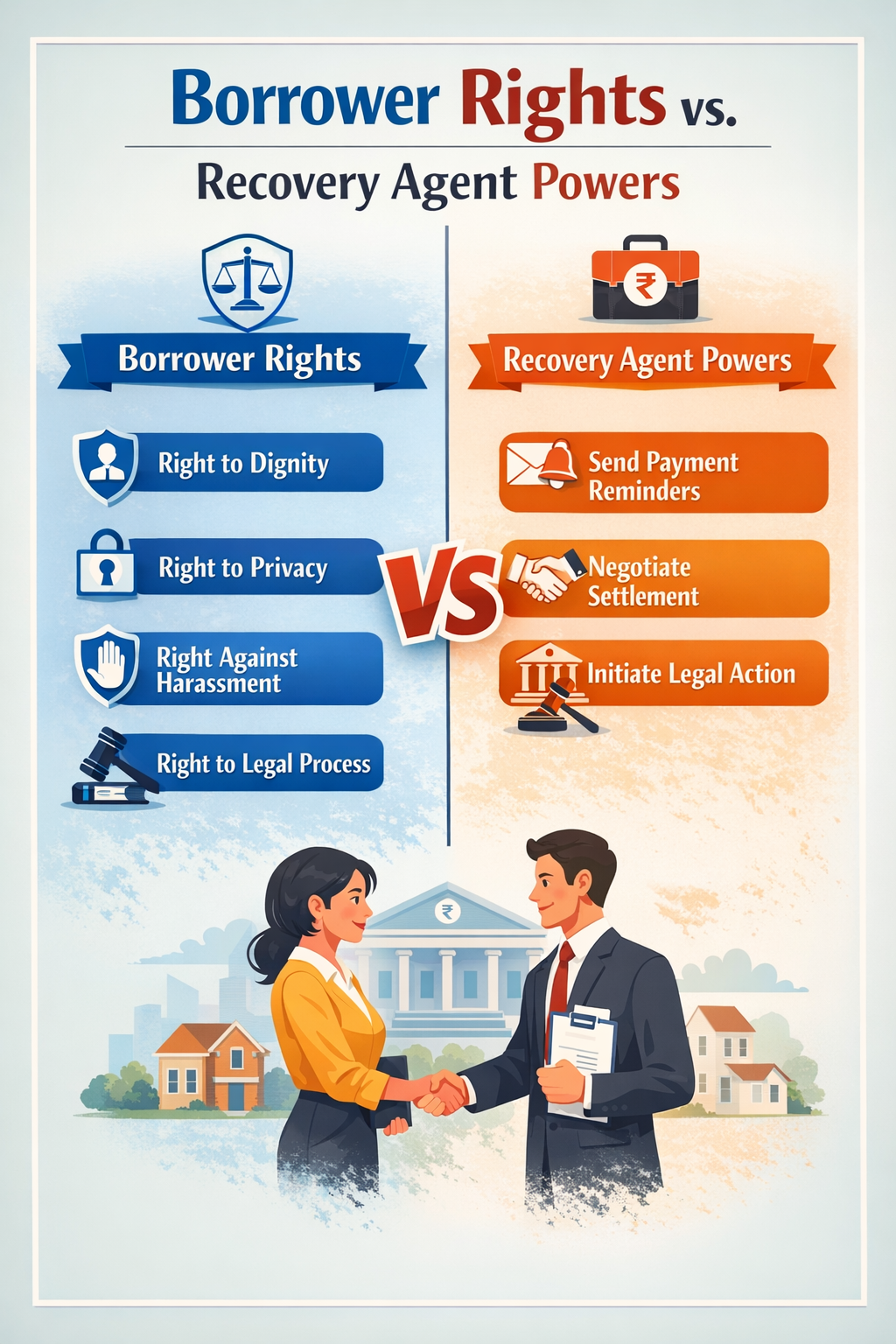
What Loan Recovery Agents Are Legally Allowed to Do
Despite restrictions, recovery agents can legally perform certain actions.
1. Contact the Borrower
They may contact you through:
-
Phone calls
-
Emails
-
Written notices
for repayment reminders.
2. Visit the Borrower
Agents may visit your:
-
Residence
-
Business premises
but must behave respectfully.
3. Negotiate Settlement
Agents can help arrange:
-
Loan restructuring
-
Settlement
-
EMI rescheduling
4. Initiate Legal Proceedings
Banks may:
-
File civil recovery suits
-
Approach Debt Recovery Tribunal
-
Initiate SARFAESI proceedings
Borrower Rights Under Indian Law
Borrowers have several legal protections.
Right to Dignity
Even if you default on a loan, you have the right to:
-
Personal dignity
-
Freedom from harassment
Right to Privacy
Recovery agents cannot publicly disclose your financial situation.
Right to Legal Due Process
No bank can:
-
Seize property without legal procedure
-
Arrest you without court orders
Supreme Court Judgment on Recovery Agent Harassment
ICICI Bank Ltd v. Prakash Kaur (2007)
The Supreme Court strongly criticized banks using strong-arm recovery tactics.
The Court held:
Banks cannot employ musclemen for loan recovery.
The judgment emphasized that recovery must follow lawful procedures only.
Manager, ICICI Bank v. Shanti Devi Sharma
The Court ruled that harassment by recovery agents violates constitutional protections.
What To Do If Recovery Agents Harass You
If you are facing harassment, take the following steps.
Step 1: Document Everything
Maintain records such as:
-
Call recordings
-
Messages
-
Emails
-
CCTV footage of visits
Evidence strengthens your complaint.
Step 2: Contact the Bank
File a complaint with the bank’s:
Grievance Redressal Officer
Banks must respond within 30 days.
Step 3: File RBI Complaint
You can lodge a complaint through:
RBI Complaint Management System (CMS)
Website: https://cms.rbi.org.in
Step 4: File Police Complaint
If threats or intimidation occur, file an FIR under:
-
Section 503 IPC – Criminal intimidation
-
Section 506 IPC – Criminal threats
-
Section 509 IPC – Insult to modesty
Step 5: Approach Consumer Court
Borrowers can file complaints under:
Consumer Protection Act 2019
for:
-
Deficiency of service
-
Unfair trade practice
How Lawyers Can Stop Recovery Harassment
A legal expert can help by:
-
Issuing legal notices to banks
-
Filing injunctions against recovery agents
-
Filing complaints before RBI and consumer courts
-
Negotiating settlements
When Banks Can Legally Recover Loans
Banks can recover loans through lawful methods such as:
SARFAESI Act
For secured loans above ₹1 lakh.
Debt Recovery Tribunal (DRT)
For debts above ₹20 lakh.
Civil Recovery Suit
For unsecured loans.
Frequently Asked Questions (FAQs)
Can recovery agents threaten me with arrest?
No. Recovery agents cannot threaten arrest. Only courts can issue arrest orders.
Can recovery agents visit my workplace?
Yes, but they must behave respectfully and cannot cause embarrassment.
Can recovery agents call at night?
No. Calls are allowed only between 7 AM and 7 PM.
Can recovery agents seize my property?
Only through legal procedures such as SARFAESI or court orders.
What if recovery agents abuse me?
You can file a police complaint and RBI complaint.
Conclusion
Loan defaults can create financial stress, but borrowers must not be subjected to harassment or intimidation. RBI has issued clear rules requiring banks and recovery agents to follow ethical and lawful recovery practices.
If you face harassment from recovery agents, remember:
-
You have legal rights
-
RBI regulations protect borrowers
-
Courts strongly condemn aggressive recovery practices
By documenting harassment and taking legal action when necessary, borrowers can protect themselves from unlawful recovery tactics.