

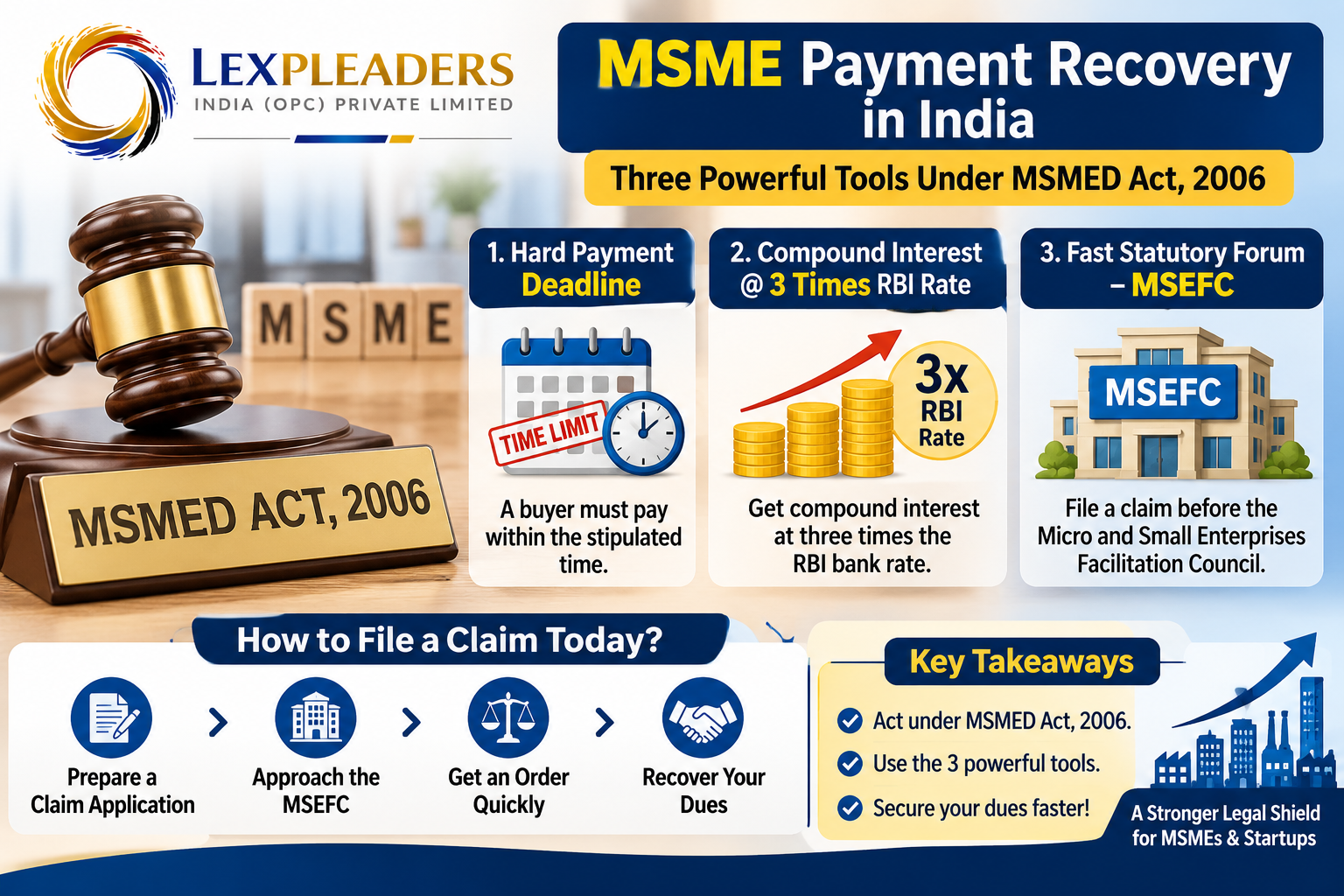
Quick answer: Under Section 16 of the MSMED Act, 2006, a buyer who delays payment to a micro or small enterprise supplier owes compound interest with monthly rests at three times the RBI Bank Rate. The Bank Rate is reported at 5.75% (October 2026), so the rate is 17.25% a year. Any agreement to the contrary is void.
Interest on delayed payment to MSME suppliers is the strongest weapon a small vendor holds against a late-paying buyer. The law fixes the rate, fixes the start date and bars the buyer from contracting out. This guide explains how Section 16 of the Micro, Small and Medium Enterprises Development Act, 2006 (MSMED Act) works, how to calculate the amount, and how to recover it.
Contents
- Who can claim interest
- The interest rate in 2026
- When interest starts: the 15-day and 45-day rules
- How to calculate interest (worked example)
- Key judgments
- Step-by-step recovery
- How startups can benefit under the MSME Act
- Common mistakes
- FAQs
Who can claim interest on delayed payment to MSME suppliers
Only a “supplier” can claim under Chapter V of the Act. Section 2(n) limits that term to micro and small enterprises that hold Udyam registration. Medium enterprises fall outside the statutory interest regime. The buyer can be a company, a firm, an individual, a government department or a PSU.
The supplier must supply goods or render services. Courts have split on works contracts, so contractors should read our note on a works contract under the MSMED Act before filing.
| Enterprise class (from 1 April 2025) | Investment limit | Turnover limit | Covered by Chapter V? |
|---|---|---|---|
| Micro | Up to Rs 2.5 crore | Up to Rs 10 crore | Yes |
| Small | Up to Rs 25 crore | Up to Rs 100 crore | Yes |
| Medium | Up to Rs 125 crore | Up to Rs 500 crore | No |
The registration date matters. In Swiss Garnier Genexiaa Sciences v Avant Garde Cleanroom (Madras High Court, 9 September 2024), the court prima facie held that the Council had jurisdiction only over a supplier registered as micro or small at the relevant time. That was a view on a waiver application, not a final ruling, but it warns suppliers to register early.
The interest rate in 2026: three times the Bank Rate
Section 16 sets compound interest with monthly rests at three times the Bank Rate notified by the Reserve Bank of India. The words “notwithstanding any agreement” override any lower contractual rate. The RBI raised the repo rate by 25 basis points to 5.50% on 7 October 2026, and a secondary report puts the Bank Rate at 5.75% after that decision.
| Item | Figure (as reported, October 2026) |
|---|---|
| RBI repo rate | 5.50% |
| Bank Rate | 5.75% |
| Section 16 rate (3 x Bank Rate) | 17.25% per annum |
| Monthly rate used for compounding | About 1.4375% |
The Bank Rate changes with RBI policy. Apply the rate that was in force for each period of delay, and confirm the current figure on the RBI website before you send a demand.
When interest starts: the 15-day and 45-day rules
Section 15 sets the payment deadline. If the parties have no written agreement, the buyer must pay before the “appointed day”, which is the day after 15 days from acceptance or deemed acceptance of the goods or services. If the parties have a written agreement, the credit period cannot exceed 45 days from acceptance or deemed acceptance.
| Situation | Interest starts from |
|---|---|
| No written agreement on credit period | Day after 15 days from acceptance or deemed acceptance |
| Written agreement of 45 days or less | The agreed date |
| Written agreement longer than 45 days | The 45-day limit applies, so interest runs after day 45 |
Deemed acceptance arises when the buyer objects in writing neither on receipt nor within 15 days of delivery. Suppliers should therefore keep delivery challans, e-way bills and emailed invoices.
How to calculate interest on delayed payment to MSME dues
The formula is: Interest = Principal x [(1 + r/12)^n – 1], where r is the annual rate and n is the number of months of delay. The calculation below assumes a constant 17.25% rate for illustration only.
| Unpaid principal | Months overdue | Interest at 17.25% (monthly rests) |
|---|---|---|
| Rs 10,00,000 | 3 | About Rs 43,748 |
| Rs 10,00,000 | 6 | About Rs 89,410 |
| Rs 10,00,000 | 12 | About Rs 1,86,813 |
Real claims need a month-by-month schedule because the Bank Rate moves. A claim should also treat part-payments carefully. The High Courts of Bombay (DSL Enterprises v MSEDCL, 2018) and Jharkhand (Rungta Projects v SAIL, 2012) have applied part-payments first to interest and then to principal, according to a published commentary.
Key judgments on Section 16 interest
| Case | Court and date | Holding in brief |
|---|---|---|
| Silpi Industries v Kerala SRTC | Supreme Court, 2021 | The MSMED Act is special, beneficial law and prevails over the Arbitration Act where the two conflict. |
| Gujarat State Civil Supplies Corp v Mahakali Foods | Supreme Court, 2022 | Disputes routed through the Facilitation Council follow the MSMED framework, and private agreements cannot dilute it. |
| Indian Highways Management Co v Sowil Ltd | Delhi High Court, single judge 21 Dec 2021; Division Bench 14 Feb 2022 | Sections 15 to 17 create substantive rights to interest that do not depend on a Section 18 reference. |
| Unicon Engineers v Super Steam Boiler Engineers | Supreme Court, order of 13 Aug 2026 | The 75% Section 19 deposit covers the full award, including MSMED interest, and the court can allow instalments but not a waiver. |
The Delhi High Court in Indian Highways rejected the buyer’s argument that Section 31(7) of the Arbitration Act caps interest. A special leave petition against the Division Bench order was reported pending in December 2022. Its later status is not confirmed here.
For interest after an arbitral award, see our guide to post-award interest in arbitration.
Step-by-step: how to recover interest on delayed payment
- Check eligibility. Confirm that your Udyam class is micro or small and that your registration pre-dates the supply.
- Collect proof. Gather the purchase order, invoice, challan, delivery proof, ledger and emails showing acceptance.
- Prepare the interest schedule. Calculate interest month by month at three times the applicable Bank Rate.
- Send a legal notice. Demand principal plus Section 16 interest and give a short deadline.
- Choose the forum. File a reference before the Micro and Small Enterprises Facilitation Council (MSEFC), usually through the Government’s MSME ODR portal, or sue in a civil or commercial court.
- Use the Council process. The Council first conciliates and then arbitrates or refers the matter to an institution, under Section 18.
- Execute the award. A Council award is enforceable like a decree. See our guide to execution of a decree in India.
The buyer who wants to challenge the award must deposit 75% of the awarded sum, as Section 19 requires. That rule gives suppliers real leverage, and our complete guide to MSME payment recovery covers it in more detail.
| Route | Best for | Interest claim |
|---|---|---|
| MSEFC reference (Section 18) | Registered micro and small suppliers | Statutory rate under Section 16 |
| Summary suit (Order XXXVII CPC) | Written, liquidated claims | Court-awarded interest; plead Section 16 where eligible |
| Commercial suit | Complex disputes above the specified value | Court-awarded interest |
| Insolvency (Section 9 IBC) | Undisputed debt above Rs 1 crore | Principal and contractual interest |
Other routes are explained in legal action for non-payment of invoices in India and in our note on the summary suit under Order XXXVII CPC.
How startups can benefit under the MSME Act
A startup that supplies goods or services to larger customers can register on Udyam as soon as it qualifies. Registration costs nothing and unlocks Chapter V rights from that date. Startups should do four things:
- Register on Udyam before the first large invoice, and keep the certificate with the contract file.
- Write a credit period of 45 days or less into every purchase order or master services agreement.
- Record acceptance in writing, because deemed acceptance starts the clock.
- Add the statutory interest clause to invoices and send a reminder once the appointed day passes.
A startup that is itself a buyer from MSME vendors should also pay within the time limits. Section 43B(h) of the Income-tax Act, 1961 can deny a tax deduction for unpaid MSME dues beyond the permitted period, so late payment can cost the buyer twice.
Common mistakes when claiming interest
- Claiming simple interest instead of compound interest with monthly rests.
- Using one Bank Rate for the whole period when the RBI changed it.
- Relying on a 90-day or 120-day contract clause that exceeds the 45-day statutory limit.
- Filing before checking that Udyam registration pre-dates the supply.
- Waiting too long, because ordinary limitation of three years still applies to the underlying debt.
- Treating a medium enterprise as protected by Chapter V.
FAQs on interest on delayed payment to MSME
What is the interest rate on delayed payment to an MSME?
Section 16 requires compound interest with monthly rests at three times the RBI Bank Rate. At a reported Bank Rate of 5.75%, that is 17.25% a year.
Within how many days must a buyer pay an MSME supplier?
The buyer must pay by the agreed date, which cannot exceed 45 days from acceptance or deemed acceptance. With no written agreement, payment is due before the appointed day, which falls after 15 days.
Can the buyer and supplier agree on a lower interest rate?
No. Section 16 applies notwithstanding any agreement, and the Supreme Court has held that private terms cannot dilute the Act’s protections.
Does the MSMED Act protect medium enterprises?
No. Section 2(n) covers only micro and small enterprise suppliers registered under the Act, so a medium enterprise must use ordinary civil remedies.
Can I claim interest if the buyer has already paid the principal?
Yes, courts have allowed interest claims after principal payment, and a Gauhati High Court report supports this view. Check the latest ruling in your High Court before filing.
Where do I file a claim for delayed MSME payment?
File a reference before the MSE Facilitation Council of the supplier’s state, usually through the Government’s ODR portal, or file a civil or commercial suit.
Sources and references
- SCC Times: RBI hikes repo rate to 5.50% (9 Oct 2026)
- LiveLaw: The Stringency of Interest Provisions Under MSMED Act
- SCC Times: When is the interest rate under Section 16 applicable?
- SCC Times: Madras High Court on Swiss Garnier
- Unicon Engineers v Super Steam Boiler Engineers (Supreme Court)
Last updated: 7 November 2026
Need help recovering delayed MSME dues?
Lex Pleaders advises MSMEs, startups, banks, NBFCs and businesses on recovery of dues and commercial disputes. WhatsApp or call 8595333579 (https://wa.me/918595333579) or write to lexpleadersindia@gmail.com to discuss your matter. Our chamber is at Chamber No. 209, C.K. Daphtary Block, Supreme Court of India, New Delhi – 110001. We are a law firm in Delhi NCR that handles MSME recovery matters.
Disclaimer: This article offers general information only and does not constitute legal advice.