

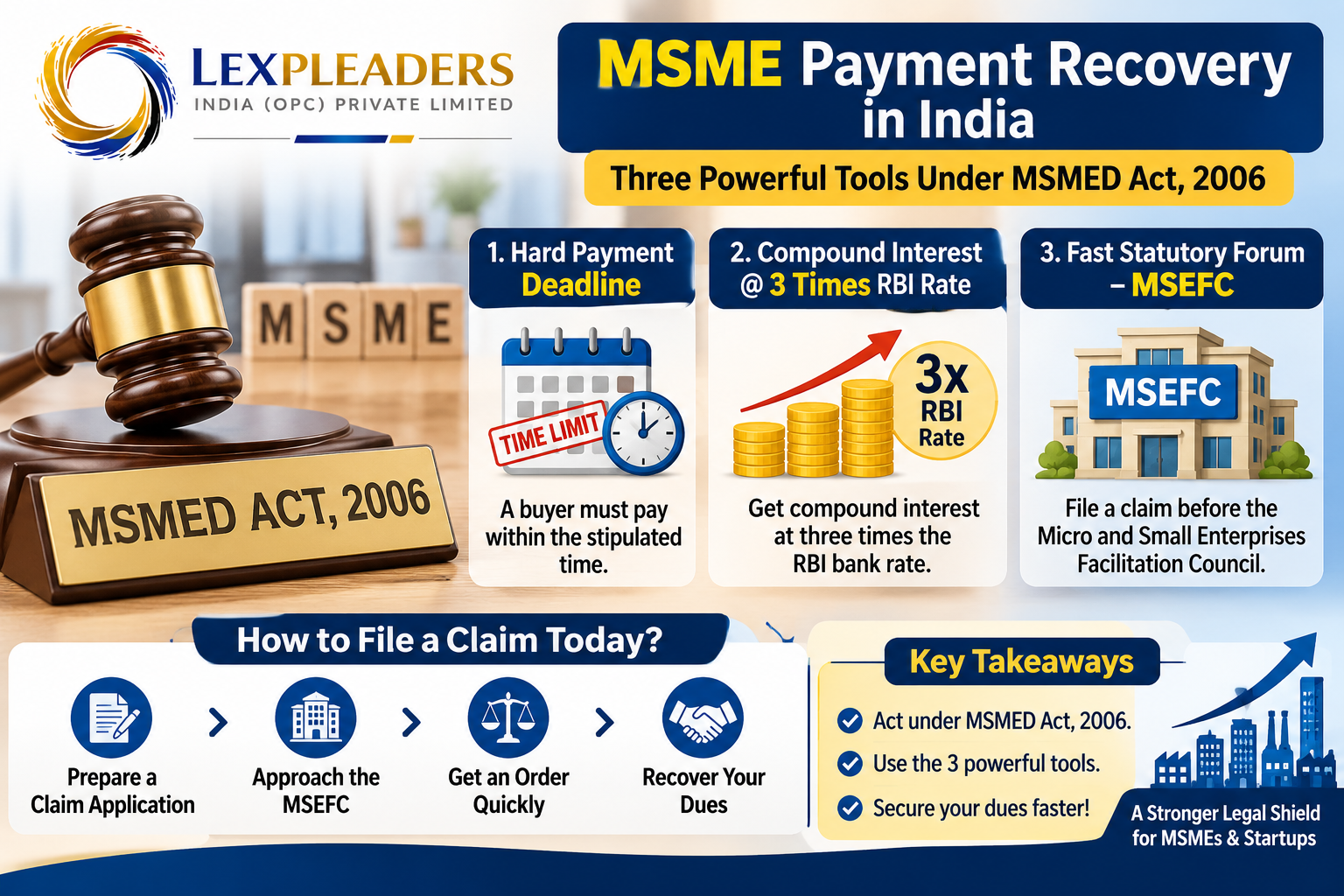
Quick answer: Under the Section 19 MSMED Act pre-deposit rule, a buyer must deposit 75% of the amount awarded by the Facilitation Council before any court hears its challenge to the award. The Supreme Court treats this as mandatory. Courts may allow payment in instalments, but they cannot waive or reduce the 75%.
The Section 19 MSMED Act pre-deposit is the main hurdle for a buyer who wants to challenge an award in favour of a micro or small supplier. This article explains what the rule says, how courts apply it, and what a supplier should do after winning a Council award.
What does Section 19 of the MSMED Act say?
Section 19 bars a court from entertaining an application to set aside a decree or award passed by the Facilitation Council unless the applicant deposits 75% of the amount awarded. The court directs how the deposit is made. A proviso lets the court order that the deposited sum be paid to the supplier on conditions while the challenge is pending.
| Question | Position |
|---|---|
| How much must be deposited? | 75% of the amount in terms of the award or decree |
| Does interest count? | Yes, per the Supreme Court’s order in Unicon Engineers (13 Aug 2026) |
| Can the court waive the deposit? | No discretion to waive or reduce |
| Can the court allow instalments? | Yes, in appropriate cases |
| Can the supplier withdraw the money? | Yes, on conditions the court sets |
Key judgments on the 75% deposit
In Tirupati Steels v Shubh Industrial Component (Supreme Court, 19 April 2022), Justices Shah and Nagarathna held that the 75% deposit is mandatory. They set aside a High Court order that had let the challenge proceed without it. The Court noted that instalments are possible where the buyer shows undue hardship.
In Unicon Engineers v Super Steam Boiler Engineers (Supreme Court, order of 13 August 2026), Justices Pardiwala and Vinod Chandran held that the 75% is computed on the full award, including MSMED interest. The Court repeated that it cannot waive or reduce the sum. It allowed the deposit within two months.
| Case | Court | Point decided |
|---|---|---|
| Tirupati Steels v Shubh Industrial Component | Supreme Court, 2022 | Deposit is mandatory; instalments on hardship |
| Docket Care Systems v Hariwill Electronics | Allahabad High Court, 2024 | Court may allow instalments; automatic dismissal for non-deposit was unwarranted |
| Swiss Garnier v Avant Garde Cleanroom | Madras High Court, 9 Sept 2024 | Deposit waived prima facie where the supplier was not registered at the relevant time |
| WAPCOS v Virgo Aqua | Delhi High Court (Division Bench), 2026 | Apparent nullity of an award can be examined without the deposit |
| Unicon Engineers v Super Steam Boiler | Supreme Court, 13 Aug 2026 | 75% includes interest; no waiver |
The Delhi High Court’s WAPCOS decision shows the narrow exception. The court allowed an appeal where the record showed that the Council had skipped a required notice, and it treated the buyer’s earlier deposit of 75% of the principal as a sign of good faith. Because the Supreme Court later held that interest forms part of the base, buyers and suppliers should treat WAPCOS as fact-specific.
Step-by-step: what a supplier should do after a Council award
- Check the award. Confirm the principal, the Section 16 interest and the date of the award.
- Watch the challenge window. A buyer files its Section 34 application under the Arbitration Act, so track the limitation period.
- Insist on the deposit. Raise the Section 19 objection at the first hearing and ask the court to list the application only after the deposit.
- Apply to withdraw the deposit. Seek release to the supplier on a refundable-security basis.
- Prepare for execution. If the buyer does not deposit, ask for dismissal and begin execution, as explained in execution of a decree in India.
Startup tip: use the deposit as leverage
A startup supplier with a Council award can use Section 19 in settlement talks. A buyer facing a 75% cash deposit often prefers a negotiated payment. Keep the Udyam certificate and acceptance records ready, because buyers often attack jurisdiction first.
Common mistakes
- Computing the 75% on principal alone and ignoring awarded interest.
- Assuming a High Court can waive the deposit under Article 226.
- Failing to ask the court to release the deposit to the supplier.
- Skipping the Udyam registration check before filing the reference.
For the wider picture, read our complete guide to MSME payment recovery and our note on a works contract under the MSMED Act.
FAQs on the Section 19 MSMED Act pre-deposit
Is the 75% pre-deposit under Section 19 mandatory?
Yes. The Supreme Court held in Tirupati Steels (2022) that a court cannot entertain the challenge until the buyer deposits 75% of the awarded amount.
Can the court reduce or waive the 75% deposit?
No. In Unicon Engineers (August 2026) the Supreme Court said courts may allow instalments but cannot waive or reduce the sum.
Does the 75% include interest?
Yes. The Supreme Court calculated it on the full award, including MSMED compound interest.
Can the deposit be paid in instalments?
Yes, where the buyer shows hardship, the court may fix instalments, as the Allahabad High Court did in Docket Care Systems (2024).
Can the supplier withdraw the deposited amount?
Yes. Section 19 allows the court to release the deposit to the supplier on conditions that protect the buyer if the challenge succeeds.
Sources and references
- Verdictum: Section 19 pre-deposit mandatory (Supreme Court)
- Unicon Engineers v Super Steam Boiler Engineers
- Verdictum: Docket Care Systems (Allahabad High Court)
- SCC Times: Madras High Court on Swiss Garnier
- WAPCOS Ltd v Virgo Aqua (Delhi High Court)
Last updated: 7 November 2026
Won a Council award or facing one?
Lex Pleaders advises MSMEs, startups, banks, NBFCs and businesses on recovery of dues and commercial disputes. WhatsApp or call 8595333579 (https://wa.me/918595333579) or write to lexpleadersindia@gmail.com to discuss your matter. Our chamber is at Chamber No. 209, C.K. Daphtary Block, Supreme Court of India, New Delhi – 110001. We are a law firm in Delhi NCR that handles MSME recovery matters.
Disclaimer: This article offers general information only and does not constitute legal advice.