

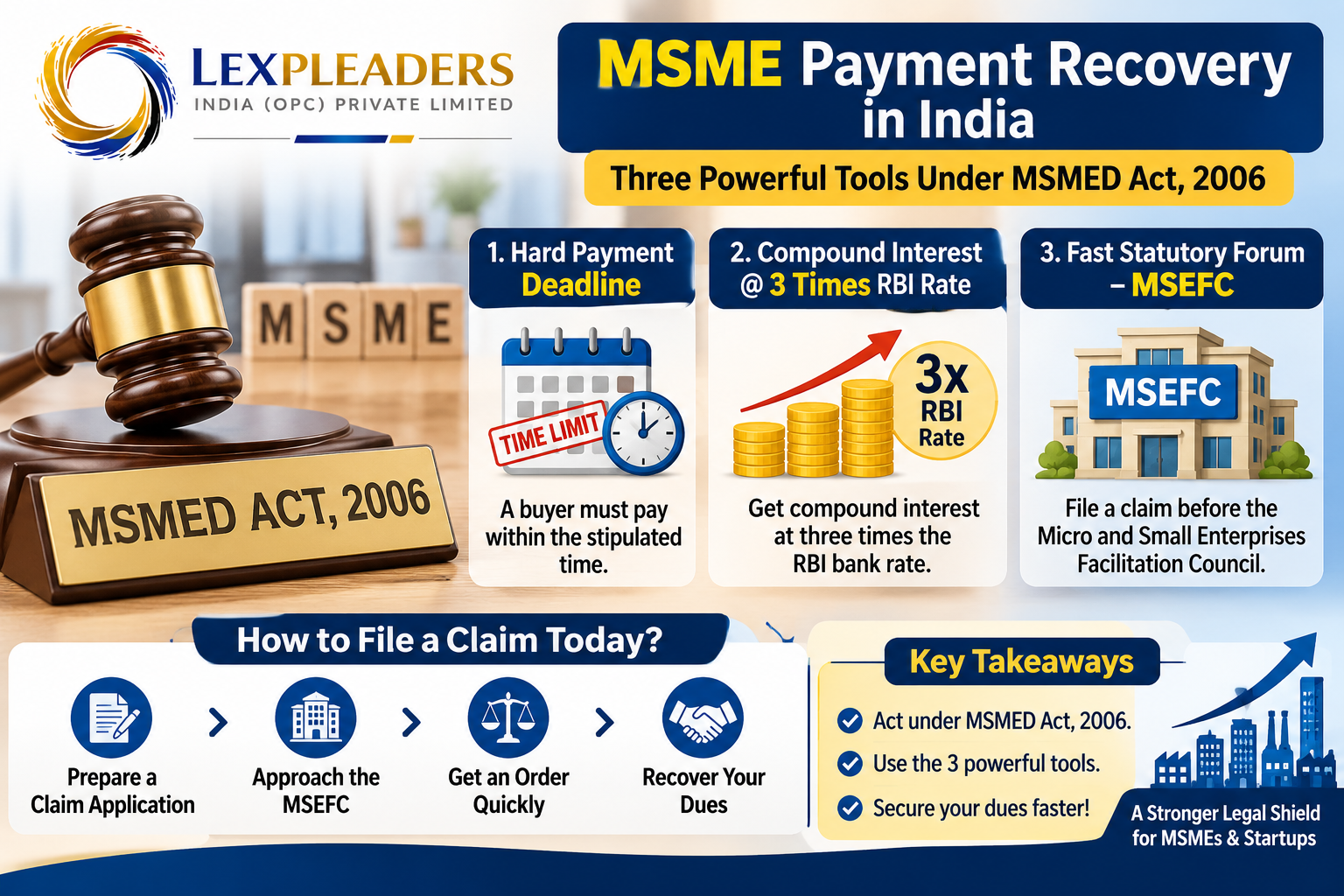
Quick answer: An MSME supplier can recover dues from a government department or PSU by filing a reference with the Micro and Small Enterprises Facilitation Council where the supplier is located. The Supreme Court has held that the MSMED Act overrides contractual seat and arbitration clauses. Late payment attracts interest at three times the RBI Bank Rate, compounded monthly.
Many suppliers wait years for payment from a ministry, a state department or a public sector undertaking. If you want to recover MSME dues from a government department, you do not have to follow the tender’s arbitration clause. The MSMED Act, 2006 gives micro and small suppliers a statutory route that courts have upheld against public buyers.
Why a government buyer is not exempt
Sections 15 to 18 of the MSMED Act apply to every buyer, public or private. The buyer must pay within the agreed period, which cannot exceed 45 days from acceptance. If it pays late, it owes compound interest with monthly rests at three times the RBI Bank Rate.
The RBI raised the repo rate to 5.50% on 7 October 2026, as one published report states. That report puts the Bank Rate at 5.75%, so the interest rate works out to 17.25% a year, compounded monthly. The Bank Rate can change at each policy review, so confirm the current figure against the RBI notification before you claim. Our guide on MSME payment recovery in India explains the full process.
Key judgments on government and PSU buyers
| Case | Court and date | Holding |
|---|---|---|
| Gujarat State Civil Supplies Corp. v. Mahakali Foods | Supreme Court, 31 October 2022 | Chapter V of the MSMED Act overrides the Arbitration Act. An existing arbitration agreement does not stop a Section 18 reference. |
| Harcharan Dass Gupta v. Union of India (2025 INSC 689) | Supreme Court, May 2025 | ISRO was the buyer. A Bengaluru seat clause could not defeat the Delhi supplier’s reference. The Council where the supplier sits has jurisdiction. |
| NBCC (India) Ltd. v. State of West Bengal (2025 INSC 54) | Supreme Court, 10 January 2025 | A two-judge bench said prior registration is not essential, then referred the question to a three-judge bench. A recent report still describes it as pending. |
| Lokopriya Gopinath Bordoloi Regional Institute v. Green Alliance Engineering | Gauhati High Court, 18 November 2025 | An autonomous health institute argued its GeM contract fixed arbitration at Tezpur. The court declined to interfere under Article 226 and left the jurisdiction objection to the arbitration stage. |
The Delhi High Court also followed NBCC in TPL-KIPL Joint Venture v. MSEFC (13 October 2026). It held that a party can invoke Section 18 even if it registered after the contract. That case involved a main contractor, not a government buyer, and the larger-bench question remains open.
Step-by-step: how to recover the dues
- Check your status. Confirm your Udyam registration and the date you registered. Our note on Udyam registration after supply of goods explains the risk of late registration.
- Gather proof of acceptance. Collect the work order, challans, inspection reports and the unpaid bills.
- Send a written demand to the department’s accounts officer and keep the receipt.
- File a reference with the Facilitation Council that covers your place of business, in the form the Council accepts, including the MSME ODR portal where it is available.
- Attend conciliation. If the department stays away, the Council can proceed to arbitration.
- Do not file a Section 11 petition midway. In April 2026, the Delhi High Court (Jubilant Marketing v. Robbins Tunneling) held that such a petition fails while conciliation is pending.
- Enforce the award. The buyer must deposit 75% of the award amount before it challenges the award. See our article on the Section 19 pre-deposit rule.
Objections government buyers usually raise
- The tender or GeM contract names a different seat.
- The supplier registered on Udyam after the contract.
- The work is a works contract. The High Courts have split on this point, as our article on works contracts under the MSMED Act shows.
- The claim is a contract dispute, not a delayed-payment claim.
Startup tip
A startup that sells to a ministry or PSU should register on Udyam before the work order. It should also keep every acceptance email. Public buyers often pay late, and clean records shorten the dispute.
Common mistakes
- Following the tender’s arbitration clause without checking the MSMED route.
- Registering on Udyam after the supply.
- Skipping the written demand.
- Ignoring the 75% deposit rule when the department challenges the award.
Frequently asked questions
Can an MSME claim interest from a government department?
Yes. Section 16 applies to all buyers. Late payment attracts compound interest at three times the RBI Bank Rate, with monthly rests.
Does a GeM or tender arbitration clause stop an MSME reference?
No. The Supreme Court in Mahakali Foods held that an arbitration agreement does not bar a Section 18 reference. Courts have applied that rule to public buyers.
Which Council has jurisdiction over a PSU buyer?
The Council where the supplier is located has jurisdiction. The Supreme Court applied this in Harcharan Dass Gupta, where ISRO was the buyer.
Can I file in the High Court instead?
You can file a civil suit, but the Council route is usually faster. A writ petition is not an easy shortcut, as the Gauhati High Court’s 2025 ruling shows.
What if I registered on Udyam after the contract?
The law is unsettled. The Supreme Court has referred the question to a larger bench, so seek legal advice before you file.
Sources and references
- SCC Online: Mahakali Foods (2022)
- Verdictum: Harcharan Dass Gupta, 2025 INSC 689
- Supreme Court: NBCC (India) Ltd. v. State of West Bengal, 10 January 2025
- Gauhati High Court: Lokopriya Gopinath Bordoloi Regional Institute v. Green Alliance Engineering Services
- Delhi High Court: TPL-KIPL Joint Venture v. MSEFC (13 October 2026)
- Corp Law Updates: RBI repo rate and Bank Rate, October 2026
Last updated: 9 November 2026
Talk to a lawyer about your government dues
Lex Pleaders, a law firm in Delhi NCR, advises MSMEs, startups, banks, NBFCs and businesses on recovery of dues and commercial disputes. WhatsApp or call 8595333579 (https://wa.me/918595333579) or write to lexpleadersindia@gmail.com to discuss your matter. Chamber No. 209, C.K. Daphtary Block, Supreme Court of India, New Delhi – 110001.
Disclaimer: This article offers general information only and does not constitute legal advice.