

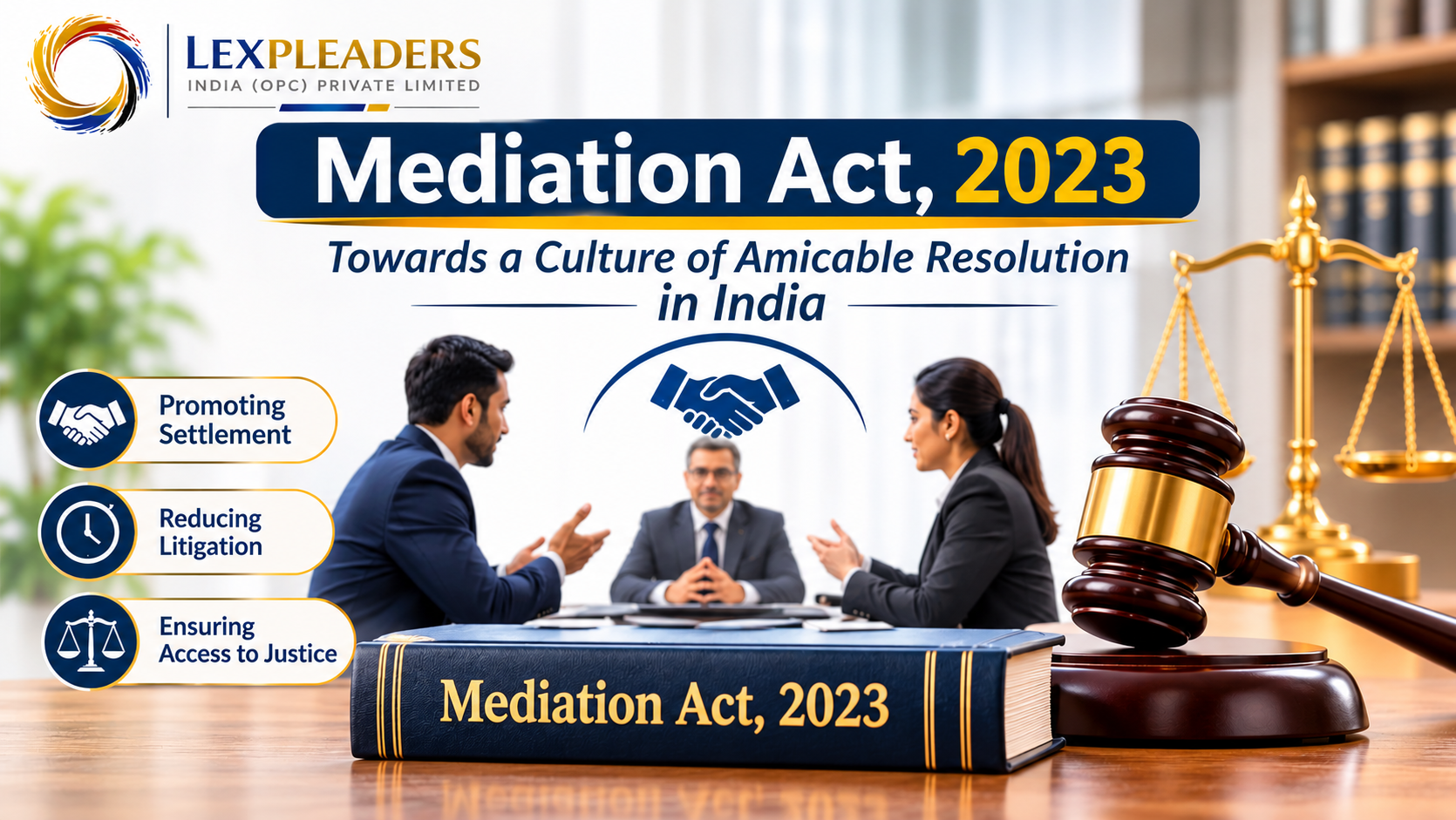
Quick answer: The Mediation Act 2023 creates a statutory framework for voluntary mediation in India, with a 120-day time limit, enforceable settlement agreements and narrow challenge grounds. However, the government notified only part of the Act in October 2023. Its core procedural and enforcement provisions are still awaiting notification, so Section 12A of the Commercial Courts Act still governs commercial disputes.
The Mediation Act 2023 is India’s first standalone law on mediation. Parliament passed it in 2023, and the President gave assent on 14 September 2023. However, much of it is not yet in force. This guide explains what the Act says, which parts operate today, and what banks, NBFCs and companies should do now.
What Is the Mediation Act 2023?
The Act sets out a single code for pre-litigation, court-referred, institutional, online and community mediation. It also sets rules on confidentiality and settlement.
Notably, the Act treats mediation as voluntary. Section 5 says parties may opt for pre-litigation mediation by mutual consent. Commercial disputes of specified value, however, continue to follow Section 12A of the Commercial Courts Act, 2015.
Which Provisions of the Mediation Act 2023 Are in Force?
The Central Government notified selected sections on 9 October 2023. These cover the Mediation Council of India (Sections 31 to 38), the Mediation Fund (Sections 45 to 47) and certain miscellaneous provisions. Then, on 27 August 2026, the government issued a notification under Section 31(1) establishing the Council, with its head office in Delhi.
By contrast, the provisions that matter most in practice still await notification. These include Section 5 (pre-litigation mediation), Section 18 (time limit), Section 27 (enforcement) and Section 28 (challenge). Therefore, parties must still enforce settlements through consent decrees or arbitral awards on agreed terms.
How Mediation Will Work Under the Act: Key Steps
Once notified, mediation will follow these steps:
- Consent: Both parties agree to mediate, with or without a prior mediation clause.
- Appointment: The parties choose a registered or empanelled mediator.
- Sessions: The mediator meets the parties, in person or online with written consent (Section 30).
- Time limit: The mediator must finish within 120 days of the first appearance. The parties may extend this by up to 60 days (Section 18).
- Settlement: The parties sign a written settlement, and the mediator authenticates it (Section 19).
- Enforcement: A court enforces the settlement under the CPC as if it were a decree (Section 27).
Disputes You Cannot Mediate
Section 6 and the First Schedule exclude several matters. The list covers criminal prosecutions, tax levies, land acquisition, and claims involving minors or persons of unsound mind. It also bars disputes affecting third-party rights.
Confidentiality and Challenge
Section 22 keeps all mediation communications confidential. Parties cannot rely on admissions or proposals made in mediation before any court or tribunal.
Section 28 allows a challenge only on four grounds: fraud, corruption, impersonation, or mediation of a dispute unfit for mediation. The party must file within 90 days of receiving the settlement. The court may allow a further 90 days for sufficient cause.
Key Case Law
- Patil Automation v. Rakheja Engineers (SC, 2022): The Supreme Court held pre-institution mediation under Section 12A mandatory. Courts must reject non-compliant plaints filed on or after 20 August 2022.
- Dhanbad Fuels v. Union of India (2025 INSC 696): On 15 May 2025, the Court reaffirmed Section 12A. It allowed courts to keep older suits pending and refer the parties to mediation.
- Babasaheb Kalyani v. Sugandha Hiremath (Bom HC, 2026): Justice Rajesh S. Patil read Section 5 as voluntary. He refused to push an unwilling party into mediation in a civil suit.
What Banks, NBFCs and Businesses Should Do Now
First, add a tiered clause to loan and commercial contracts: mediation, then arbitration. Second, set a fixed mediation window so the clause cannot delay recovery. Third, record any settlement as a consent award or decree until Section 27 takes effect. Finally, keep Section 12A compliance in mind before you file any commercial suit. See our guide on the Section 12A exemption and our arbitration and ADR services.
FAQs on the Mediation Act 2023
Is the Mediation Act 2023 in force?
Only partly. The Council and Fund provisions apply, but the core procedure and enforcement sections await notification.
Is mediation mandatory in India?
Generally, no. The Act treats mediation as voluntary, but Section 12A of the Commercial Courts Act makes pre-institution mediation mandatory for most commercial suits.
How long does mediation take under the Mediation Act 2023?
The mediator must complete the process within 120 days of the first appearance. The parties can extend it by up to 60 more days.
Is a mediated settlement agreement enforceable?
Once Section 27 takes effect, courts will enforce it like a civil court decree. Until then, parties should record it as a consent decree or award.
Can you challenge a mediated settlement?
Yes, but only for fraud, corruption, impersonation or an unfit dispute. You must apply within 90 days, extendable by 90 days.
What is the difference between mediation and arbitration?
A mediator helps parties reach their own deal, while an arbitrator decides the dispute through a binding award.
Lex Pleaders advises banks, NBFCs and businesses on mediation, arbitration and dispute resolution strategy across India. Write to us at lexpleadersindia@gmail.com to discuss your matter.
Disclaimer: This article offers general information only and does not constitute legal advice.