

Contesting a GST demand, from the notice stage to the tribunal
Most tax disputes are decided long before they reach a tribunal. The reply to a show-cause notice fixes the record, and an appeal largely argues about that record. Lex Pleaders India (OPC) Private Limited acts in GST and income tax disputes from the notice stage, through departmental appeals, to the GST Appellate Tribunal and writ proceedings before the High Courts.
Our tax litigation practice
The firm’s tax work is contentious rather than compliance-led. It begins where a client disputes an assessment, a demand or an attachment. Moreover, the firm handles it as it handles commercial litigation: establish what the department must prove, find where the record is weak, then build the reply around that.
Key areas of GST and tax dispute work
- Show-cause notices and demands — replies to notices, including proceedings under Section 74A of the CGST Act and the time limits that govern them.
- Departmental appeals — first appeals under Section 107, the filing checklist, the limitation period and the pre-deposit.
- Appeals to the GST Appellate Tribunal — filing before the GSTAT, the pre-deposit payable, and applications to stay recovery pending appeal.
- Input tax credit — denial and reversal of credit, credit on construction and immovable property, and the relief Sections 16(5) and 16(6) allow for earlier periods.
- Provisional attachment — challenges to attachment of bank accounts under Section 83, where the statutory conditions and the one-year limit frequently decide the matter.
- Registration — cancellation and retrospective cancellation, and applications to revoke within the prescribed period.
- Income tax — reassessment notices, the time limits that apply, and the appellate proceedings that follow.
- Writ remedies — where an order lacks jurisdiction, breaches natural justice, or where no alternative remedy works.
Pre-deposit, limitation and stay before the GST Appellate Tribunal
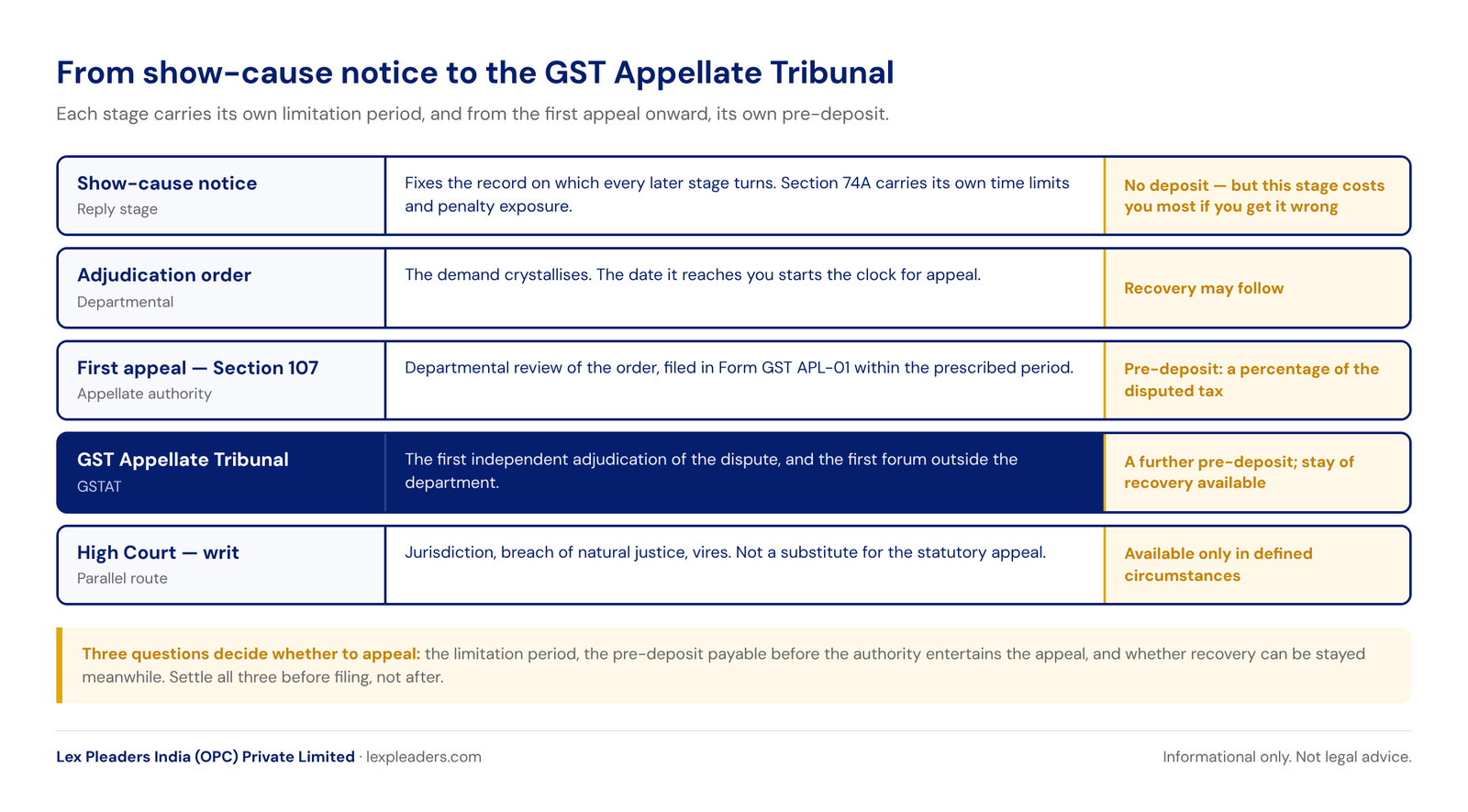
Three practical questions decide whether a tax appeal is worth filing, and when. First, the limitation period. Second, the pre-deposit payable before the authority entertains the appeal. Third, whether anyone can stay recovery meanwhile. Therefore the firm settles all three at the outset, so a client knows the cash cost of contesting before committing to it. The GST Appellate Tribunal publishes its case status and filing information on its own portal.
Who we act for
The firm acts for companies and partnerships facing GST demands and audits. In addition, it acts for contractors and infrastructure businesses, where input tax credit and reimbursement questions arise out of project contracts. It also acts for individuals and businesses answering income tax reassessment.
Why clients instruct Lex Pleaders on tax disputes
Litigation-led, not compliance-led
Clients instruct the firm when they are contesting a position. The firm then conducts the matter through to the tribunal or the High Court.
Sector knowledge where tax meets contract
Construction and infrastructure disputes frequently carry a GST question — reimbursement, credit on works, or the treatment of claims. Because of that, the firm’s infrastructure practice sits alongside its tax practice.
A clear view of the cash cost
The firm addresses pre-deposit and stay before filing, not after.
Partner-led and Supreme Court based
Partners conduct matters directly, and the firm maintains a chamber at the Supreme Court of India.
Frequently asked questions
How long do I have to appeal a GST order?
Appeals carry a prescribed limitation period, with a limited window to condone delay. That period runs from communication of the order, so the date you received it matters.
Is a pre-deposit always required?
You ordinarily pay a percentage of the disputed tax before the authority entertains an appeal, and a further amount at the tribunal stage. However, confirm the exact proportions for the period and the forum.
What does the GST Appellate Tribunal decide?
It gives the first independent adjudication of the dispute, outside the department. You can follow current filing and case status through the CBIC GST portal and the tribunal’s own site.
Can a bank account attached under Section 83 be released?
Provisional attachment carries statutory conditions and a maximum duration. Courts have set attachments aside where the department satisfied neither, or recorded no reasons.
Can a cancelled GST registration be restored?
Revocation remains available within the prescribed period. Moreover, High Courts have granted relief where the department cancelled retrospectively without adequate reasons.
Should I file an appeal or a writ petition?
An appeal is ordinarily the correct route. However, a writ petition is available in defined circumstances, including want of jurisdiction and breach of natural justice.
Speak to the tax litigation team
For how a GST dispute moves from show-cause notice through the first appeal to the tribunal, and the pre-deposit payable at each stage, see our guide to GST and tax litigation in India.
The firm’s practice covers GST and income tax dispute work before the departmental authorities, the GSTAT and the High Courts. Contact details are on the contact page, and our notes sit under tax litigation.
This page is for information only. It is not legal advice and does not create a lawyer–client relationship. Rates, thresholds and limitation periods change, so confirm the position for the relevant period.