

Matrimonial matters before the family courts
Matrimonial disputes turn on evidence, procedure and timing as much as on the merits. Lex Pleaders India (OPC) Private Limited acts as divorce lawyers in Delhi, and appears in maintenance, custody, domestic violence and matrimonial property matters. The firm works across the family courts of Delhi NCR, the High Courts and the Supreme Court of India.
First, the firm establishes what outcome is realistically available — settlement, contested relief, or interim protection. Then it builds the record for that outcome from the first filing rather than the last hearing.
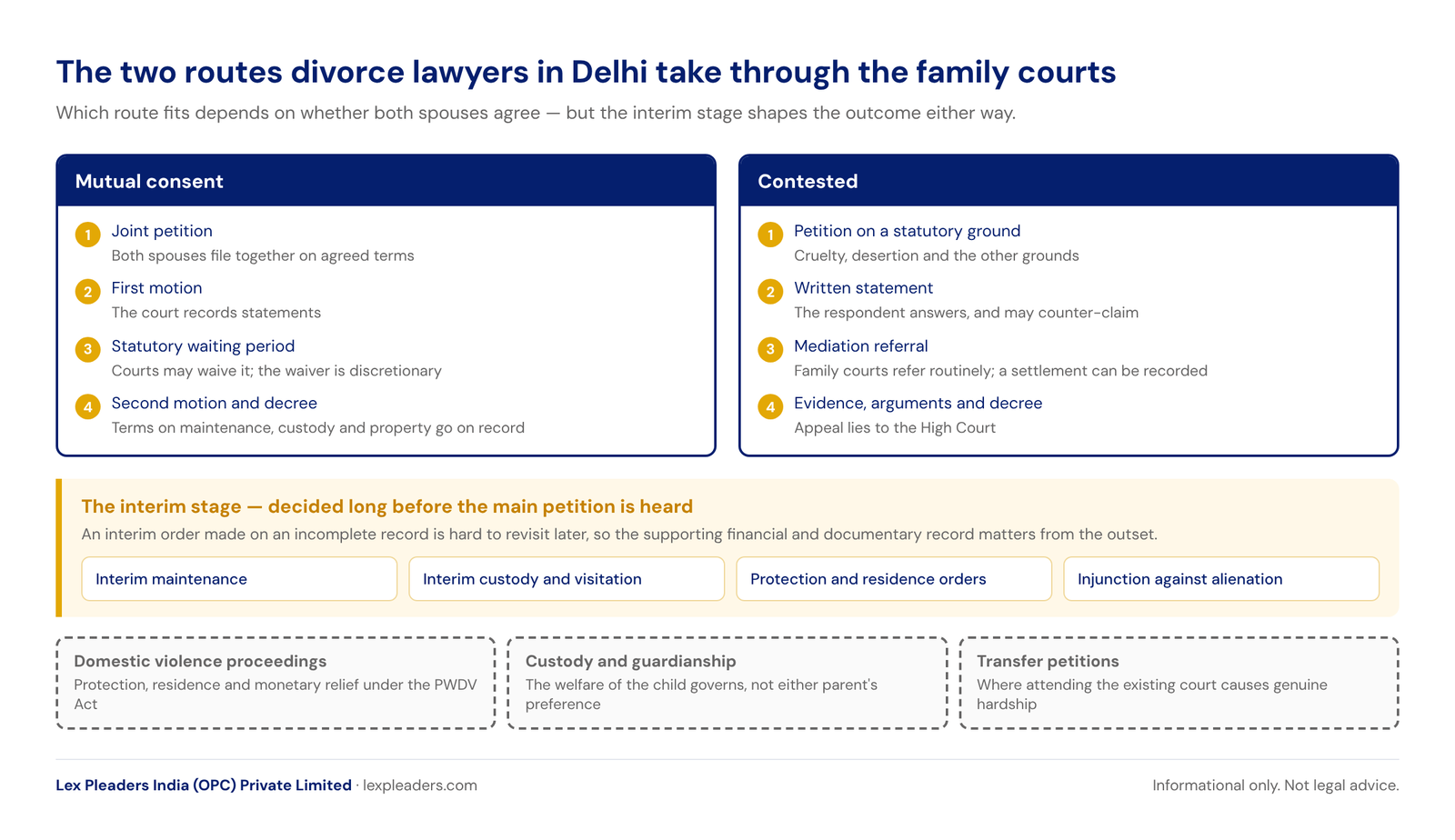
How divorce lawyers in Delhi approach a family matter
Family litigation differs from commercial litigation in one important respect. The parties usually remain connected after the case ends, through children, property or shared obligations. Therefore the firm’s practice reflects that. Where a negotiated outcome serves the client, the firm pursues it properly and records the terms so that they bind. Where it does not, the firm litigates.
Key areas of family law
- Divorce — mutual consent petitions, contested divorce on statutory grounds including cruelty and desertion, divorce after a decree of restitution, and annulment of void and voidable marriages.
- Maintenance and alimony — interim maintenance, permanent alimony, maintenance under Section 144 of the Bharatiya Nagarik Suraksha Sanhita, affidavits of assets and liabilities, and recovery of arrears.
- Child custody and guardianship — custody, visitation and guardianship applications, habeas corpus petitions in custody disputes, and permission to deal with a minor’s property.
- Domestic violence — proceedings under the Protection of Women from Domestic Violence Act, protection and residence orders, and defence of allegations under Section 85 of the Bharatiya Nyaya Sanhita. That work runs alongside our criminal defence practice.
- Matrimonial property and stridhan — claims to the matrimonial home, recovery of stridhan, and rights in a spouse’s self-acquired and ancestral property.
- Transfer petitions and NRI matters — transfer of matrimonial proceedings between courts, questions of jurisdiction, and recognition of foreign decrees.
- Succession and testamentary — wills, probate, succession certificates and legal heir certificates, where they arise out of a family dispute.
Interim relief decides the shape of the case
In most matrimonial matters the interim stage sets the terms for everything after it. Courts decide interim maintenance, interim custody, protection orders and injunctions against alienation long before they hear the main petition. Therefore the firm prepares those applications with the supporting financial and documentary record attached from the outset. An interim order made on an incomplete record is hard to revisit afterwards.
Who we act for
The firm acts for spouses on either side of a matrimonial dispute. It also acts for parents and grandparents in custody matters, and for older people in residence and maintenance proceedings. In addition, it acts for non-resident Indians whose proceedings span more than one jurisdiction.
Why clients instruct divorce lawyers in Delhi at this firm
Partner-led conduct of sensitive matters
Partners handle matrimonial files directly rather than passing them down. That matters, because the facts are personal and instructions change as circumstances do.
A realistic assessment at the outset
At the first consultation, clients hear what relief is likely, what it will take to obtain it, and roughly how long it should take.
Settlements recorded properly
Where matters settle, the firm records the terms so that maintenance, custody and property arrangements hold without fresh litigation.
Appellate capability
The firm appears before the High Courts and maintains a Supreme Court practice. As a result, a matter that needs an appeal does not have to go to another firm.
Where divorce lawyers in Delhi from this firm appear
Most of the firm’s matrimonial work sits before the family courts of Delhi, Noida, Ghaziabad and Gurugram. Listing practice, mediation referral and interim maintenance practice all differ between those jurisdictions. Our office is in Sector 2, Noida, with a chamber at the Supreme Court of India. You can check the status of a pending matter yourself on eCourts India Services.
Frequently asked questions
How long does a mutual consent divorce take?
It depends on the court, and on whether it waives the statutory waiting period between the first and second motion. Courts decide that waiver on the facts of each case, so no fixed timeline applies.
Can an earning wife claim maintenance?
Earning capacity is one factor among several. It does not by itself defeat a claim. Instead, courts compare the standard of living during the marriage with the position after separation.
Who gets custody of a child?
The welfare of the child governs, not the preference of either parent. Courts weigh the child’s age, schooling, existing arrangements and, where the child is old enough, their own wishes.
Can matrimonial proceedings move to another city?
You may file a transfer petition where attending the existing court causes genuine hardship. However, distance alone rarely suffices, so the application must establish the difficulty.
Is mediation compulsory?
Family courts refer matrimonial matters to mediation routinely. Taking part does not prejudice a contested case. Moreover, a settlement reached in mediation can be recorded and enforced.
Can I get help if I cannot afford a lawyer?
Yes. The Delhi State Legal Services Authority provides free legal aid and mediation services at every court complex in Delhi.
Speak to the family law team
The firm’s practice covers matrimonial, custody and maintenance litigation across Delhi NCR and before the appellate courts. Contact details are on the contact page, and our published notes sit under family law.
This page is for information only. It is not legal advice and does not create a lawyer–client relationship. Confirm the position for the facts of a particular matter.