

Defence at every stage of a BNSS proceeding
Criminal matters are won or lost early. What you say at the investigation stage matters. So does whether you seek anticipatory bail before or after arrest. So does how your first application reads. Lex Pleaders India (OPC) Private Limited acts as criminal lawyers in Delhi, and appears before the trial courts, the High Courts and the Supreme Court of India.
Since 1 July 2024 the Bharatiya Nagarik Suraksha Sanhita has replaced the Code of Criminal Procedure, and the Bharatiya Nyaya Sanhita has replaced the Indian Penal Code. As a result, procedure, section numbering and several timelines all changed. The firm’s published notes track those changes section by section. You can read the text of the BNSS, 2023 in full.
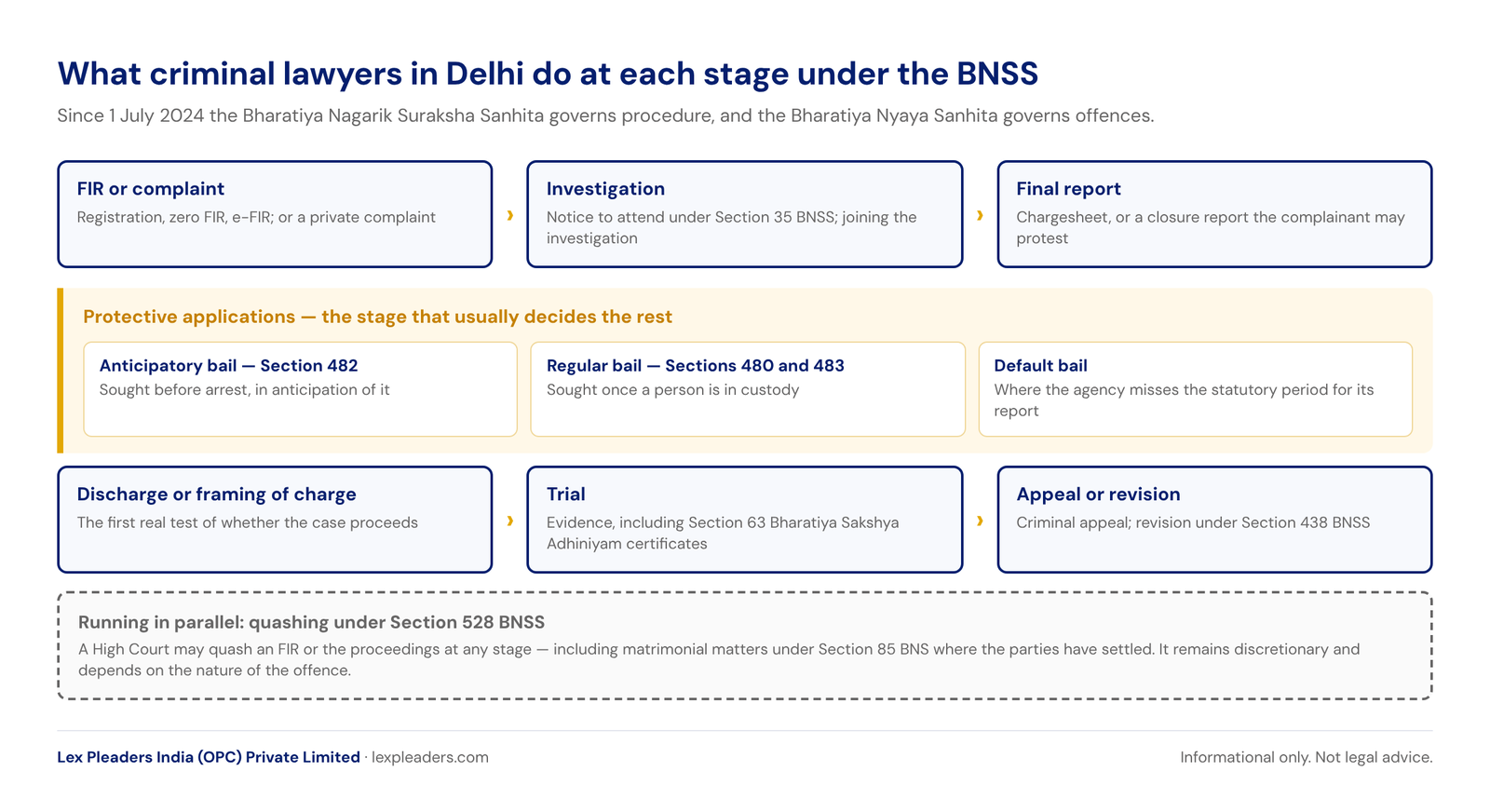
What criminal lawyers in Delhi handle day to day
The firm’s criminal work divides into two strands. First comes urgent protective work: anticipatory bail, regular bail, and replies to notices and summons during investigation. Then comes the longer conduct of a defence — discharge, trial, revision and appeal. The firm handles both. In addition, it acts for complainants where a private complaint or a protest petition is the right route.
Key areas of criminal defence
- Bail — anticipatory bail under Section 482 BNSS and the conditions courts impose; regular bail under Sections 480 and 483; and default bail where the agency misses its deadline for the report.
- FIR and investigation stage — registration of an FIR, zero FIR and e-FIR, replies to a Section 35 BNSS notice, and applications under Section 175(3) asking a magistrate to direct an investigation.
- Quashing — petitions under Section 528 BNSS to quash an FIR or proceedings, including matrimonial cases under Section 85 BNS where the parties have settled. That work commonly runs alongside matrimonial proceedings.
- Economic and white-collar offences — cheating under Section 318 BNS, criminal breach of trust under Section 316, and forgery under Section 336. The line between a civil dispute and a criminal offence often decides these matters.
- Cheque dishonour — prosecution and defence under Section 138 of the Negotiable Instruments Act, interim compensation under Section 143A, the deposit under Section 148 on appeal, and compounding.
- Trial, revision and appeal — discharge applications, trial in absentia under Section 356 BNSS, criminal revision under Section 438, and criminal appeals.
- Evidence — certificates under Section 63 of the Bharatiya Sakshya Adhiniyam for electronic evidence, which now decide the admissibility of a great deal of material.
Acting at short notice
Anticipatory bail, debit freeze applications and replies to summons are time-critical. Therefore, the firm establishes the facts and the available documents on the day it receives instructions. An application filed on a thin record invites conditions that are hard to vary afterwards.
Who we act for
The firm acts for individuals and company directors facing investigation or prosecution. It also acts for complainants in cheque dishonour and economic offence matters. In addition, it acts for banks and non-banking financial companies pursuing prosecution for dishonoured instruments and mandates.
Why clients instruct criminal lawyers in Delhi at this firm
Current on the BNSS and BNS
The firm builds its work and its published notes on the new sanhitas rather than the superseded codes. That matters most where both the numbering and the substance changed.
Economic offences alongside commercial litigation
Many criminal matters grow out of a commercial dispute. Because the firm also runs banking, insolvency and commercial litigation practices, it can conduct both strands together.
Partner-led and Supreme Court based
Partners conduct matters directly. The firm also maintains a chamber at the Supreme Court of India for appellate and special leave work.
Candid advice on exposure
Clients hear the realistic range of outcomes. Sometimes a settlement or a quashing petition serves them better than a contested trial, and the firm says so.
Where criminal lawyers in Delhi from this firm appear
The firm appears before the district courts in Delhi, Noida, Ghaziabad and Gurugram, the Delhi High Court and the Supreme Court. Our office is at Sector 2, Noida, with a Supreme Court chamber.
Frequently asked questions
What is the difference between anticipatory and regular bail?
You seek anticipatory bail before arrest, in anticipation of it. You seek regular bail after you are already in custody. The tests differ, and so do the conditions courts impose.
Do I need a criminal lawyer in Delhi at the FIR stage?
Usually yes. The record formed during investigation shapes everything that follows. Early advice also prevents avoidable admissions.
Can an FIR be quashed after the parties settle?
A High Court may quash proceedings under Section 528 BNSS after a settlement. However, it remains discretionary and turns on the nature of the offence. Courts quash less readily where the offence is treated as one against society rather than an individual.
What is default bail?
Where the agency does not file its report within the statutory period, the accused becomes entitled to bail on that ground alone. You must claim the right while it remains available.
Is a cheque bounce case criminal or civil?
Section 138 creates a criminal offence. In practice, though, the proceeding works as a recovery mechanism, with compounding and interim compensation both available.
What if I cannot afford a lawyer?
The Delhi State Legal Services Authority provides free legal aid at every court complex in Delhi.
Speak to the criminal defence team
The firm’s practice includes bail, quashing and criminal trial work. It extends to white collar crime and economic offences. Contact details are on the contact page, and our notes are collected under criminal law.
This page is for information only. It is not legal advice and does not create a lawyer–client relationship. Confirm the position for the facts of a particular matter.