

Electricity disputes in India travel through a regulatory channel before they ever reach a court. First, a Central or State Electricity Regulatory Commission decides the matter — a tariff determination, an open access refusal, a change-in-law claim, or a dispute under a power purchase agreement. Then, if a party wants to challenge that order, an appeal lies to the Appellate Tribunal for Electricity under Section 111 of the Electricity Act, 2003. Finally, from the Tribunal, a further appeal lies to the Supreme Court on a question of law.
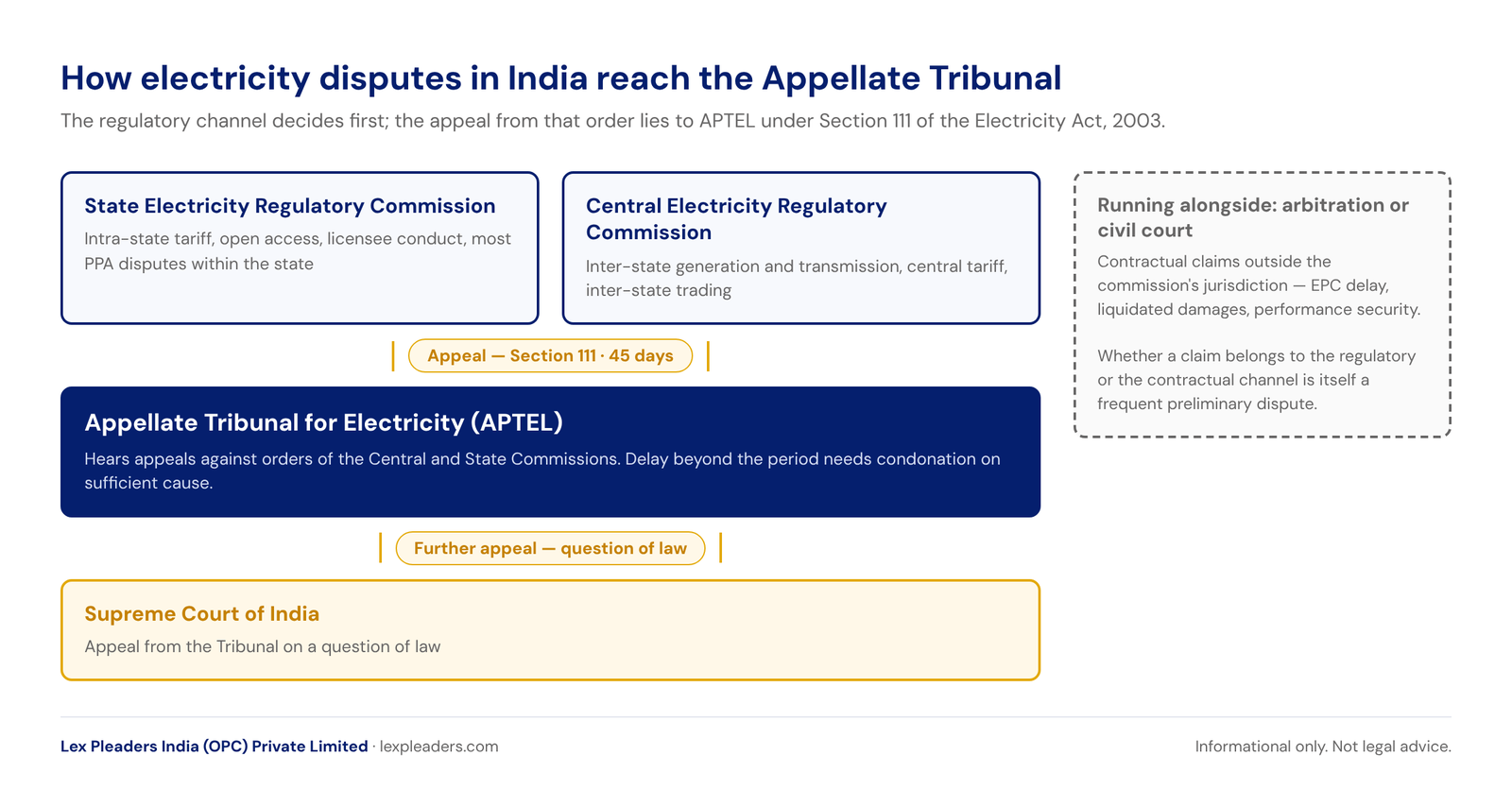
Which forum decides what
Each forum has its own subject matter. Therefore, the first question in any new matter is simply which one holds jurisdiction.
| Forum | Decides | Appeal lies to |
|---|---|---|
| State Electricity Regulatory Commission | Intra-state tariff, open access, licensee conduct, most PPA disputes within the state | APTEL |
| Central Electricity Regulatory Commission | Inter-state generation and transmission, central tariff, inter-state trading | APTEL |
| Appellate Tribunal for Electricity | Appeals against commission orders under Section 111 | Supreme Court, on a question of law |
| Arbitration or civil court | Contractual claims outside the commission’s jurisdiction | Per the contract and the Arbitration and Conciliation Act |
Moreover, the division between the regulatory and the contractual channel is itself a frequent preliminary dispute. For example, a party that starts arbitration on a matter the commission alone may decide loses time it cannot recover.
How a Section 111 appeal works
A party must file the appeal within the period Section 111 prescribes. That period runs from the date of the order, not from the date the consequences begin to bite. The Electricity Act, 2003 sets the limit at 45 days. However, once that period runs out, the appeal depends on an application for condonation of delay, and the appellant must then establish sufficient cause on affidavit rather than simply assert it. Therefore, fix the limitation position on the day the order arrives, not on the day you decide to appeal. The Appellate Tribunal for Electricity publishes its cause lists and judgments on its own website. For the procedure step by step, see our note on APTEL appeal procedure under Section 111.
Where electricity disputes in India usually arise
Although the sector is broad, the same categories recur. In practice, most matters fall into one of these:
- Tariff and truing up — capital cost disallowance, operational norms, and how the commission treats past periods on truing up.
- Change in law — whether a statutory or regulatory change after the cut-off date entitles a party to relief, and how the commission computes it.
- Open access — refusal or conditional grant, cross-subsidy surcharge, additional surcharge, and banking arrangements.
- Curtailment and deemed generation — whether a generator may claim compensation when the grid backs it down.
- Late payment and dues — recovery of outstanding dues from distribution licensees, and the late payment surcharge framework.
- Renewable purchase obligation — compliance, shortfall, and what follows from a shortfall.
- Termination — termination of a power purchase agreement, and the compensation that follows it.
Why electricity disputes in India often reach two forums at once
A generation or transmission project carries an EPC contract behind the regulatory arrangement. As a result, trouble frequently surfaces in both places at the same time — a delay claim against the contractor, and a tariff consequence before the commission. Our guide to construction and EPC claims covers the contract side, including extension of time, liquidated damages, force majeure and performance security.
What the other side will argue
- Jurisdiction — that the claim belongs before the commission, or conversely that it is purely contractual and belongs in arbitration.
- Limitation — that the appeal is out of time, and that the appellant has not explained the delay.
- Prudence — on tariff, that the claimant did not incur the cost prudently.
- Cut-off date — on change in law, that the event preceded the relevant date, or that it did not affect the claimant’s economics.
- Grid constraint — on curtailment, that the grid operator backed generation down on security grounds, which attracts no compensation.
Frequently asked questions
Do all electricity disputes in India start before a commission?
Most do, because the Electricity Act gives the commissions wide jurisdiction. However, a purely contractual claim may belong in arbitration instead, and parties often fight that point first.
How long is the appeal period under Section 111?
The Act prescribes 45 days, and that period runs from the date of the order. Still, confirm the computation against the provision and the order in your own matter.
Can the Tribunal condone delay?
Yes, on sufficient cause established on affidavit. Even so, tribunals do not grant condonation as a matter of course.
Does an appeal stay the order appealed against?
No. The appellant must apply for a stay, and the Tribunal then decides that application on its own merits.
Can a PPA dispute go to arbitration?
It depends on the agreement, and on whether the subject matter falls within the commission’s exclusive jurisdiction. In practice, parties usually raise the point as a preliminary objection.
What happens after the Tribunal?
An appeal lies to the Supreme Court on a question of law.
How we work on these matters
Lex Pleaders India (OPC) Private Limited acts for generators, licensees and open access consumers before the regulatory commissions and the Appellate Tribunal. In addition, the firm’s practice includes electricity and energy regulatory work. Contact details are on the contact page.
This page is for information only. It is not legal advice and does not create a lawyer–client relationship. Regulations and limitation periods change, so confirm the position for the particular matter.