

A gift deed transfers property without consideration. Because no money changes hands, the law compensates with form: the donee must accept the gift while the donor is alive, and for immovable property the transfer must happen by a registered instrument attested by two witnesses. Get those elements right and the transfer is difficult to undo. Get them wrong and the deed is vulnerable from the day it is signed.
This guide sets out what makes a gift deed valid, how it is registered, when it can be cancelled, and who can challenge it afterwards.
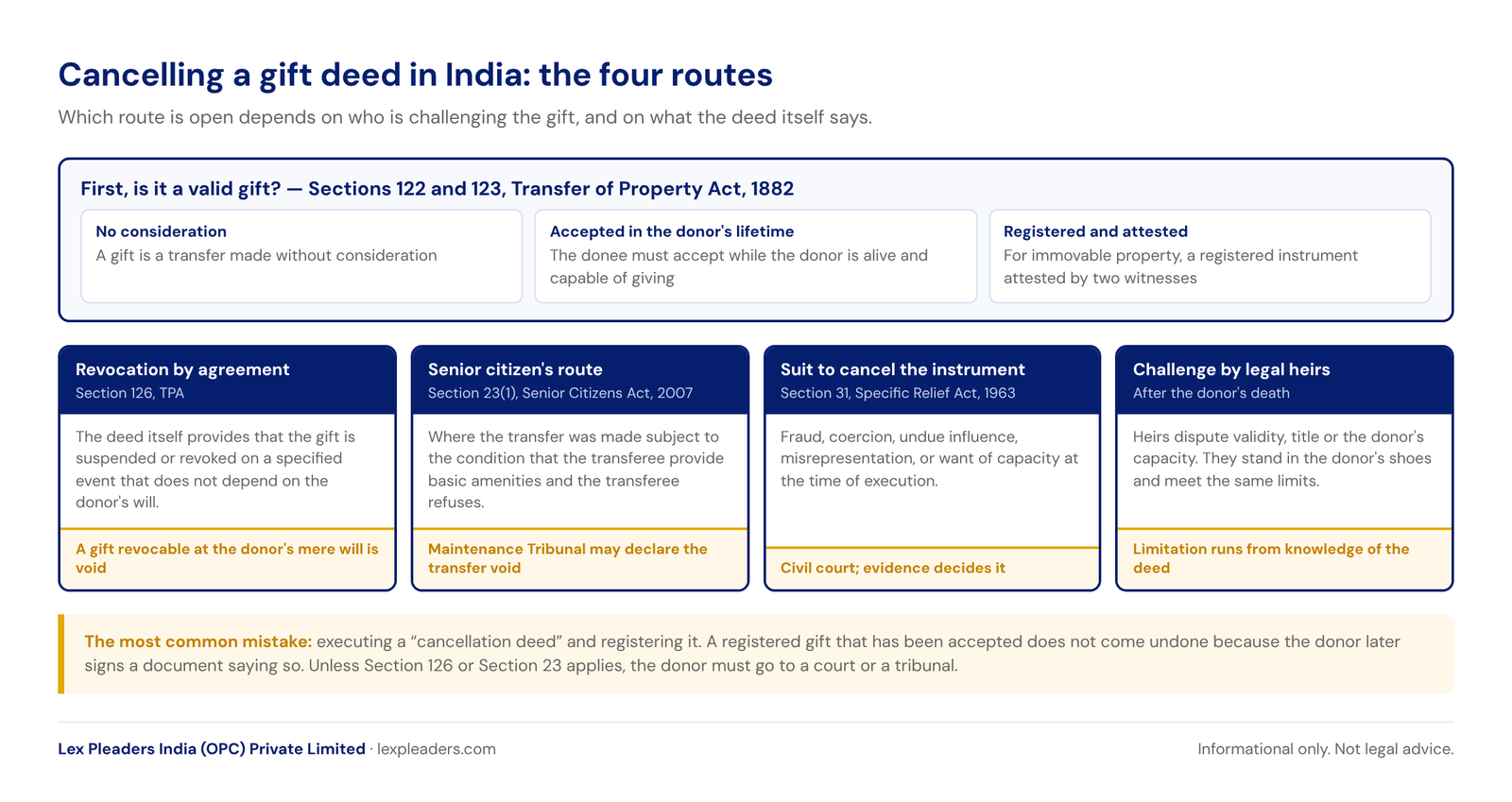
What makes a gift deed valid in India
Three requirements come from the Transfer of Property Act, 1882. Miss any one of them and the gift fails.
| Requirement | Provision | What it means in practice |
|---|---|---|
| No consideration | Section 122 | Nothing passes back to the donor. If it does, the document is a sale, whatever it calls itself. |
| Acceptance in the donor’s lifetime | Section 122 | The donee must accept while the donor is alive and still capable of giving. Acceptance can be shown by conduct, such as taking possession or mutating the record. |
| Registered and attested | Section 123 | For immovable property, a registered instrument attested by two witnesses. Nothing less will do. |
Registering a gift deed
Registration is not a formality here; it is what makes the gift of immovable property effective at all. Stamp duty and registration fees are set by each State, and several States charge a concessional rate where the gift is made to a close relative. Therefore check the rate with the registration department of the State where the property lies rather than relying on a figure quoted elsewhere. Mutation of the revenue record follows registration, and although mutation does not by itself confer title, its absence is one of the first things an opponent will point to.
When a gift deed can be cancelled
This is where most disputes start, and where the most common misconception sits. A donor who signs and registers a “cancellation deed” has not undone anything. A registered gift that the donee accepted stands until a court or a tribunal sets it aside. In practice four routes exist.
- Revocation by agreement — Section 126. The deed itself may provide that the gift is suspended or revoked if a specified event occurs, provided that event does not depend on the donor’s will. A gift that the donor may revoke at will is void.
- The senior citizen’s route — Section 23(1) of the Maintenance and Welfare of Parents and Senior Citizens Act, 2007. Where a senior citizen transferred property subject to the condition that the transferee provide basic amenities, and the transferee then refuses, the Maintenance Tribunal may declare the transfer void at the transferor’s option. Our note on whether parents can cancel a gift deed given to a son or daughter deals with this route and its conditions.
- A suit to cancel the instrument — Section 31 of the Specific Relief Act, 1963. Fraud, coercion, undue influence, misrepresentation or want of capacity at the time of execution. The civil court decides it on evidence. See cancellation of a gift deed in India: grounds, process and recent rulings.
- A challenge after the donor’s death. Legal heirs may dispute the deed, but they stand in the donor’s shoes and meet the same limits.
Who can challenge a gift deed, and on what ground
A challenge usually rests on one of two things: the deed did not meet the statutory requirements, or the donor’s consent was not free. Heirs most often argue the second, and the evidence tends to be medical records, the circumstances of execution and the conduct of the parties afterwards. For the time limits and what the courts have held, see can legal heirs challenge a gift deed in India.
A separate line of attack goes to form. Where the deed was never registered, or was merely notarised, the gift of immovable property does not take effect at all. Our note on unregistered gift deed validity covers that, including oral gifts and the position under Mohammedan law.
Gift deed or will?
The two do different jobs. A gift takes effect immediately and, once accepted and registered, is hard to reverse. A will speaks only from death and can be changed any number of times before then. As a result the choice is usually about control: a donor who wants to keep the property until death should not be executing a gift deed at all. See gift deed vs will in India.
Documents to assemble
- The registered gift deed, with the receipt and the registration endorsement.
- Title documents of the donor showing how the donor came to own the property.
- Evidence of acceptance — possession, mutation, utility records, or correspondence.
- Where capacity is in issue, medical records and any contemporaneous assessment around the date of execution.
- For the Section 23 route, material showing the condition of maintenance and the transferee’s refusal.
- Mutation records and the latest revenue extract.
What the other side will argue
- Acceptance. That the donee accepted the gift and acted on it, so the transfer is complete.
- Delay. That the challenge came years after the donor knew of the deed, and limitation has run.
- No condition in the deed. On the Section 23 route, that the deed recorded no condition of maintenance at all.
- Capacity. That the donor understood the document, and that the Sub-Registrar’s endorsement supports it.
- Third-party rights. That the property has since passed to a purchaser without notice.
A worked example
A father gifts a flat to his son by a registered deed. The son accepts it, mutates the record and moves in. Two years later the relationship breaks down and the father signs a cancellation deed before the Sub-Registrar.
That cancellation deed achieves nothing on its own. The father’s position depends entirely on what the gift deed said and what the facts show. If the deed contained no revocation clause of the kind Section 126 allows, he cannot revoke it. If he can show the transfer was subject to a condition of maintenance that the son has refused, the Maintenance Tribunal route under Section 23 may be open. Failing both, he must sue to cancel the instrument and prove a ground such as undue influence. Three very different proceedings, and the deed’s own wording decides which one is available.
Frequently asked questions
Can a registered gift deed be cancelled unilaterally?
No. Once the donee has accepted a registered gift, the donor cannot undo it by signing another document. A court or a tribunal must set it aside.
Can a gift deed be revoked if the donee mistreats the donor?
Not under Section 126 by itself, because ingratitude is not a ground there. However, where the donor is a senior citizen and the transfer carried a condition of maintenance, Section 23 of the Senior Citizens Act may apply.
Is a notarised gift deed valid?
Not for immovable property. Section 123 requires registration, and notarisation is not a substitute.
How long do heirs have to challenge a gift deed?
Limitation generally runs from when the person knew of the deed, so the date of knowledge usually matters more than the date of execution. Confirm the applicable article for the particular facts.
Does mutation prove ownership?
No. Mutation updates the revenue record for the collection of tax. It is useful evidence of acceptance and possession, but it does not confer title.
Can a gift deed be made in favour of a minor?
Yes, with acceptance on the minor’s behalf by a natural guardian. The acceptance requirement still has to be satisfied.
How we work on these matters
Lex Pleaders India (OPC) Private Limited acts in gift deed, title and succession disputes before the civil courts, the Maintenance Tribunals and the High Courts, and the firm’s practice includes real estate, RERA and land disputes. You can check the status of a pending matter on eCourts India Services. Contact details are on the contact page.
This page is for information only. It is not legal advice and does not create a lawyer–client relationship. Stamp duty, registration fees and limitation periods differ between States and change over time, so confirm the position for the particular property and the particular facts.