

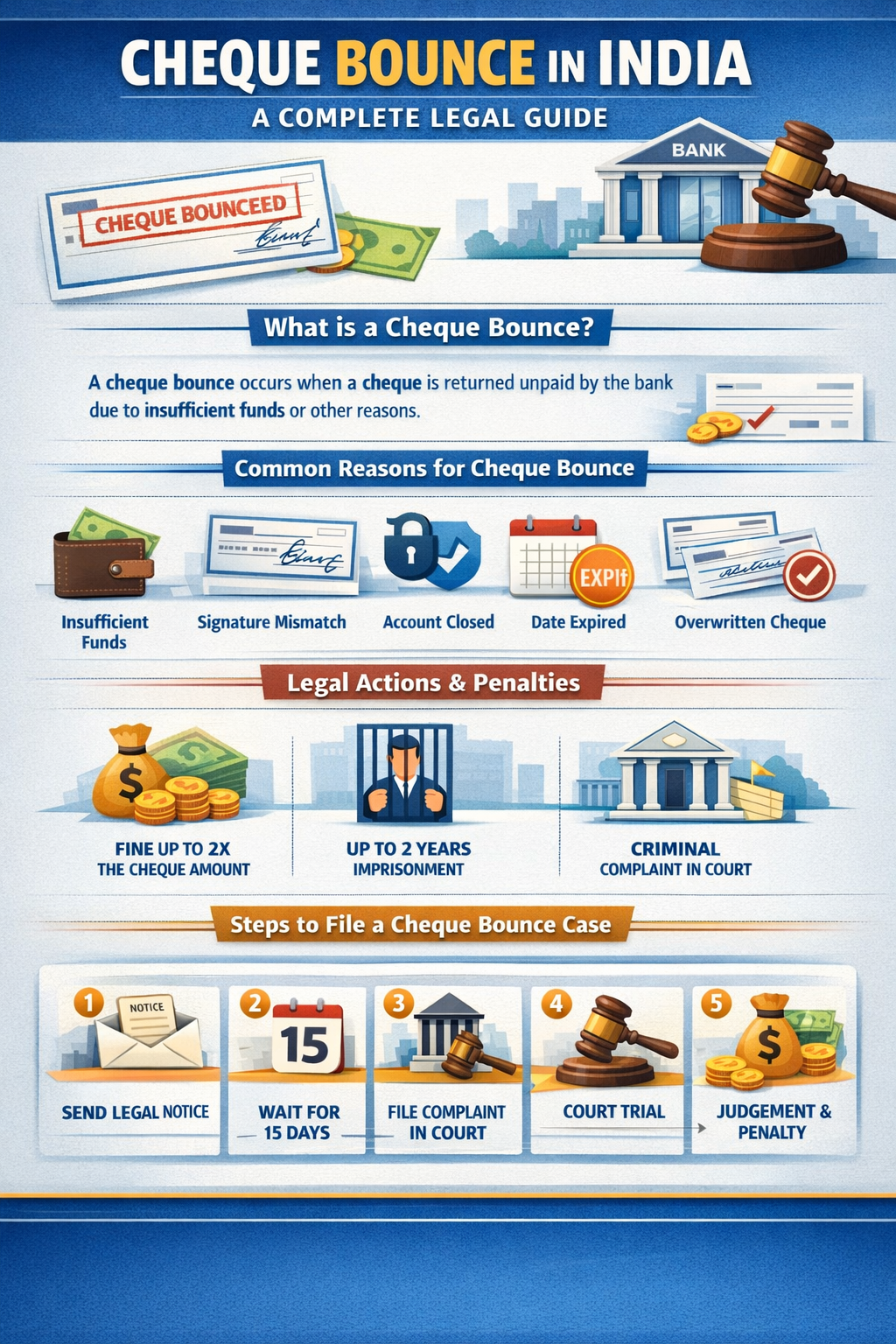
Quick answer: A cheque bounce case in India is a criminal complaint under Section 138 of the Negotiable Instruments Act, 1881. The payee must send a legal notice within 30 days of learning about the dishonour. The drawer then has 15 days to pay. If payment is not made, the payee must file the complaint within one month. The punishment is up to two years’ imprisonment, a fine of up to twice the cheque amount, or both.
What Is a Cheque Bounce?
A cheque bounces when the bank returns it unpaid. The bank issues a cheque return memo stating the reason. Section 138 applies when the cheque was issued for a legally enforceable debt or liability and was dishonoured for insufficient funds, or because it exceeds the amount the account can pay.
Essential Ingredients of Section 138
- The accused issued the cheque.
- The cheque was issued to discharge a legally enforceable debt or liability.
- The payee presented the cheque within three months of its date, or within its validity period if shorter.
- The bank returned the cheque unpaid.
- The payee sent a written demand notice within 30 days of receiving information about the dishonour.
- The drawer failed to pay within 15 days of receiving the notice.
Timeline at a Glance
| Stage | Time limit |
|---|---|
| Present the cheque | Within 3 months of the date on the cheque |
| Send legal notice | Within 30 days of receiving the return memo or dishonour information |
| Drawer pays | Within 15 days of receiving the notice |
| File complaint | Within one month after the 15-day period ends |
A court may condone delay in filing the complaint if the complainant shows sufficient cause. It cannot extend the 30-day notice period.
Punishment for Cheque Bounce
- Imprisonment up to two years
- Fine up to twice the cheque amount
- Both imprisonment and fine
Courts usually direct the accused to pay compensation to the complainant. Under Section 143A, a trial court may order the accused to pay interim compensation of up to 20% of the cheque amount. The Supreme Court held in Rakesh Ranjan Shrivastava v. State of Jharkhand (2024) that this power is discretionary, not automatic. On an appeal against conviction, Section 148 allows the appellate court to require a deposit of at least 20% of the fine or compensation.
Step-by-Step Procedure to File a Cheque Bounce Case
Step 1: Collect the cheque return memo
Keep the original cheque and the bank’s return memo. Both are core evidence.
Step 2: Send the legal notice
Send it in writing, within 30 days. State the cheque number, date, amount and reason for dishonour, and demand payment within 15 days. Use registered post or courier with proof of delivery, and email as well.
Step 3: Wait 15 days
The 15 days run from the date the drawer receives the notice. Record the delivery date.
Step 4: File the complaint
If the drawer does not pay, file a complaint before the Magistrate within one month after the 15-day period expires. The complaint is supported by the complainant’s affidavit under Section 145.
Step 5: Trial
The court issues summons, and the case is tried summarily under Section 143. Courts encourage early settlement.
Where Can You File a Cheque Bounce Case?
After Dashrath Rupsingh Rathod v. State of Maharashtra (2014), Parliament amended the Act in 2015. Under Section 142(2), the complaint is filed in the court where the payee’s bank branch is located, if the cheque was delivered for collection through an account. For a cheque presented otherwise, the place of presentation to the drawee bank applies.
Defences Available to the Accused
- No legally enforceable debt. Sections 118 and 139 presume the cheque was issued for a debt, so the accused must rebut that presumption.
- Defective notice or limitation. The notice was not sent or the complaint was filed out of time.
- Payment already made, supported by bank records.
- Cheque not issued by the accused, or signature forged.
A blank signed cheque handed over voluntarily can still attract liability, as the Supreme Court held in Bir Singh v. Mukesh Kumar (2019).
Important Supreme Court Judgments
- Rangappa v. Sri Mohan (2010): the statutory presumption favours the holder of the cheque.
- Meters and Instruments Pvt Ltd v. Kanchan Mehta (2018): encouraged early settlement of cheque bounce cases.
- Rakesh Ranjan Shrivastava v. State of Jharkhand (2024): interim compensation under Section 143A is discretionary.
- Sanjabij Tari v. Kishore S. Borcar (25 September 2025): the Court held that a cash loan of ₹20,000 or more does not stop being a legally enforceable debt merely because it breaches Section 269SS of the Income Tax Act. It also issued guidelines for faster service of summons, online payment facilities and revised compounding costs.
Cheque Bounce by a Company
Under Section 141, the company and every person in charge of its business at the time of the offence can be prosecuted. Directors who were not responsible for day-to-day conduct can show they had no knowledge of the offence or took due care.
Settlement and Compounding
The offence is compoundable under Section 147. Parties can settle at any stage, and the court may close the case once the cheque amount and agreed compensation are paid. The 2025 Supreme Court guidelines revised the costs payable for compounding at different stages.
Civil Remedies
A payee can also file a civil suit for recovery, including a summary suit under Order XXXVII of the Code of Civil Procedure, 1908, claiming interest. Criminal and civil proceedings can run together.
What to Do If You Receive a Cheque Bounce Notice
- Read the notice and check the cheque details.
- Do not ignore it. Silence can count against you.
- Consult a lawyer immediately.
- Send a reply, or pay within 15 days if the debt is genuine.
- Consider settlement if the dispute can be resolved.
How to Avoid Cheque Bounce Disputes
- Keep sufficient balance before the cheque date.
- Avoid signing blank cheques.
- Record the transaction in a written agreement.
- Do not issue cheques as “security” without clear written terms.
Frequently Asked Questions
Is cheque bounce a criminal offence in India?
Yes. Dishonour of a cheque for insufficient funds is an offence under Section 138 of the Negotiable Instruments Act, 1881, once the notice and non-payment conditions are met.
What is the time limit for sending a cheque bounce notice?
30 days from the date you receive information from the bank that the cheque was returned unpaid.
How many days does the drawer get to pay after the notice?
15 days from receipt of the notice.
What is the punishment for cheque bounce?
Up to two years’ imprisonment, a fine of up to twice the cheque amount, or both.
Can a cheque bounce case be settled?
Yes. It can be compounded at any stage, usually by paying the cheque amount with compensation.
How long does a cheque bounce case take?
It varies widely by court and workload. Many cases take years, which is why courts encourage settlement.
Can I file a cheque bounce case without a lawyer?
You can, but notice drafting, limitation and evidence are technical, and errors can end the case. Legal help is advisable.
What is the validity of a cheque?
Three months from the date written on it.
Can a case be filed against a company?
Yes. Under Section 141, the company and the persons responsible for its business can be prosecuted.
Does stop-payment save the drawer?
Not necessarily. If the cheque was issued for a legally enforceable debt, Section 138 can still apply.
Does a cash loan above ₹20,000 qualify?
Yes. In Sanjabij Tari (2025) the Supreme Court held that breach of Section 269SS does not make the debt unenforceable under Section 138.
Conclusion
Section 138 gives payees a fast route to recover money, but only if the notice, waiting period and complaint timelines are followed exactly. Missing one deadline can end the case.
For help with a cheque bounce notice or complaint, speak to our team through the contact page. You can also read about our corporate and commercial litigation services.
This article is general information, not legal advice. Laws and court guidelines change, so verify your facts with a lawyer.